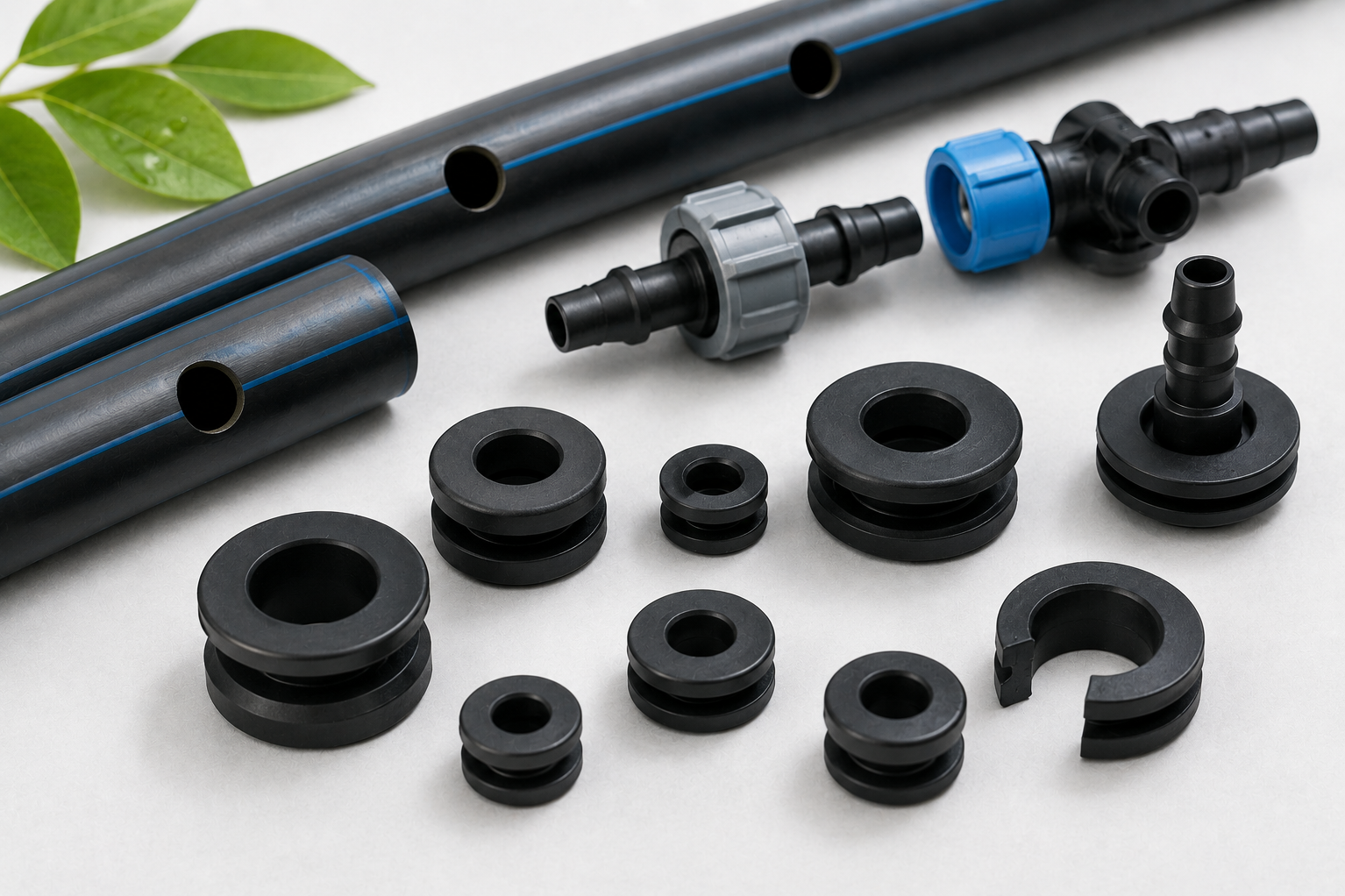
A small grommet can determine whether a drip-irrigation connection remains secure or develops repeated leakage. Vishal Rubber Technologies manufactures drip irrigation EPDM rubber grommets for irrigation equipment suppliers, pipe fitting companies and agricultural system manufacturers in Pune. Correct dimensions and compound characteristics are crucial because even minor variations may affect sealing around the take-off connector.
These grommets are generally fitted into holes made in lateral or sub-main pipes. A connector is inserted through the grommet, compressing the rubber and creating a seal between the pipe wall and fitting.
Choosing a Grommet Only by Outer Diameter
One frequent mistake is ordering according to the outside diameter without checking the complete geometry. The grommet must match the drilled hole, connector stem and pipe-wall thickness.
A technically useful drawing should specify:
- Outer diameter
- Inner diameter
- Groove diameter
- Groove width
- Overall thickness
- Lip dimensions
- Permitted tolerances
When one dimension is incorrect, the grommet may rotate, pull out, leak or make connector insertion difficult.
Ignoring the Pipe-Wall Thickness
The groove in the grommet holds it in the pipe opening. If the groove width does not suit the wall thickness, the grommet may not sit evenly.
Thin-walled pipes and thicker rigid pipes can require different grommet designs. Buyers serving agricultural projects across Maharashtra should therefore confirm the pipe specification instead of assuming that one component fits every irrigation line.
Using an Unsuitable Rubber Compound
Drip-irrigation systems are exposed to sunlight, heat, water, fertilisers and outdoor ageing. EPDM is widely considered for these conditions because it offers useful resistance to ozone, weather and water.
Compound quality still matters. An incorrectly formulated grommet may harden, crack or lose elasticity during service. The required hardness should provide enough flexibility for installation while maintaining sealing pressure after the connector is fitted.
Buyers should communicate any expected contact with:
- Fertiliser solutions
- Water-treatment chemicals
- Cleaning agents
- Agricultural sprays
- Unusually hot water
- Oils or hydrocarbon contaminants
Compatibility should be assessed using the actual fluid composition and service temperature.
Overlooking Connector Fitment
A grommet and connector work as a sealing system. Evaluating each part separately may lead to a mismatch.
A connector stem that is too large can overstretch or cut the grommet. One that is too small may not provide adequate compression. Sharp edges and moulding flash on the connector can also damage the rubber during insertion.
Testing the proposed grommet with the actual pipe and connector is a practical way to identify fitment concerns before bulk procurement.
Accepting Excessive Dimensional Variation
Inconsistent grommet dimensions can create unpredictable results across an irrigation installation. Some connectors may fit properly, while others may feel loose or require excessive force.
Manufacturing control should cover:
- Compound mixing consistency
- Moulding conditions
- Dimensional inspection
- Visual checks for cuts and flash
- Hardness verification
- Batch identification
- Sample fitment testing
Consistent dimensions are particularly important for automated assembly and large irrigation projects.
Skipping Field-Condition Testing
A component that seals during a short indoor test may behave differently after exposure to heat, pressure fluctuations and prolonged outdoor conditions. Practical evaluation should reproduce the likely installation environment wherever possible.
Pune-based irrigation product manufacturers can test samples under working pressure, repeated connector movement and temperature exposure. Leakage, pull-out resistance and rubber recovery should be observed over a suitable period.
Vishal Rubber Technologies can develop drip irrigation EPDM rubber grommets from technical drawings, approved samples and application details. Sharing the hole size, pipe thickness, connector dimensions, water pressure and expected operating conditions helps establish a more accurate product specification.
Avoiding these selection mistakes can reduce leakage complaints, difficult assembly and premature grommet replacement. The right result comes from treating the grommet, connector and pipe as one integrated sealing arrangement.