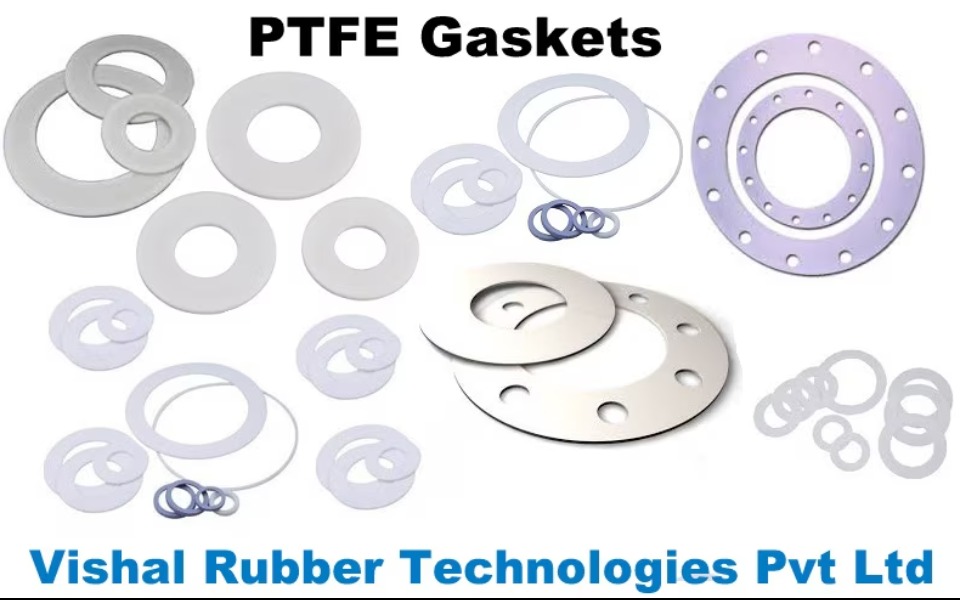
Chemical compatibility and temperature exposure often make gasket selection difficult. Vishal Rubber Technologies supplies PTFE flange gaskets for process plants, equipment manufacturers and maintenance teams in Pune. PTFE is commonly evaluated for corrosive chemicals and services where many elastomeric gaskets may swell, degrade or become unsuitable.
PTFE has broad chemical resistance and a low-friction surface. However, it is not automatically the correct gasket for every flange. Its tendency to deform gradually under sustained load must be considered during design and installation.
How PTFE Differs from Rubber Gaskets
Rubber gaskets seal by elastic compression. They can accommodate surface irregularities and usually require less seating stress, depending on their hardness and geometry.
PTFE is less elastomeric. It resists a wide range of chemicals but may creep or cold-flow under sustained pressure. This can reduce gasket stress over time if the flange design, thickness and bolt loading are unsuitable.
A simplified evaluation looks like this:
- PTFE is commonly considered for aggressive chemical media.
- EPDM is often used for water, weathering and selected mild chemicals.
- Nitrile is frequently chosen for petroleum oils and lubricants.
- Viton is evaluated for heat, fuels, oils and demanding chemical exposure.
- Neoprene serves selected general industrial and outdoor applications.
Actual compatibility must be verified using the chemical name, concentration, temperature and operating conditions.
Applications That May Suit PTFE
PTFE flange gaskets are used in industries where contamination control and chemical resistance are important. Common applications include:
- Chemical-transfer pipelines
- Pharmaceutical process systems
- Laboratory equipment
- Water-treatment plants
- Food-processing equipment
- Acid and alkali handling systems
- Solvent pipelines
- Process pumps and valves
In Pune and Maharashtra, these gaskets may be required by chemical processors, pharmaceutical manufacturers, engineering contractors and original equipment manufacturers.
Situations Requiring Extra Evaluation
PTFE may not perform as expected when a flange is weak, badly misaligned or unable to maintain sufficient bolt load. It also requires careful consideration in applications involving pressure cycling, thermal movement and significant vibration.
Before selection, examine:
- Process medium and concentration
- Operating and cleaning temperature
- Continuous and maximum pressure
- Flange material and condition
- Flange standard and pressure class
- Available bolt load
- Surface finish
- Gasket thickness
- Required purity level
- Maintenance practices
Expanded PTFE, filled PTFE and envelope-style constructions offer different properties from conventional virgin PTFE sheet gaskets. These options should not be treated as interchangeable without technical review.
Avoiding Installation Problems
The flange faces should be clean, parallel and free from deep damage. The gasket must be centred correctly and should not project into the flow path unless the design specifically requires it.
Bolts should be tightened gradually using an appropriate cross-pattern. Uneven tightening can create local stress and leakage paths. The gasket should not be reused after dismantling because its thickness and sealing surfaces may have changed.
Excessively thick PTFE gaskets may experience greater deformation. The selected thickness should be sufficient to accommodate the flange condition without unnecessarily increasing creep risk.
Information Needed for a Reliable Enquiry
Vishal Rubber Technologies can manufacture PTFE flange gaskets according to standard dimensions, drawings and approved samples. Buyers in Pune should provide the inner diameter, outer diameter, thickness, bolt-hole pattern, flange standard, process medium, temperature and pressure.
If documentation such as a material certificate, inspection report or specific grade declaration is required, it should be included in the purchase specification.
PTFE provides valuable chemical resistance, but dependable sealing depends on the full joint design. Evaluating the medium, flange arrangement and installation method together helps buyers select a gasket that matches the actual pipeline rather than relying only on a broad material description.