Thank you for writing to us. One of our executive will reach back to you through your submitted medium. In case there’s an urgency, feel free to connect over WhatsApp for faster response.
Prefer calling? Dial +918048033839 (International callers) or 08048033839 (Indian callers).
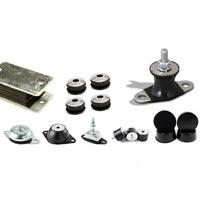
Anti-Vibration (AV) rubber mounts or Isolators are crucial components in most types of heavy machinery and equipment which help dampen noise levels and vibration frequency while safeguarding fragile components from external vibrations.
Types of Mounts :
Hexagonal Mounts
Sandwich / Isolation Mounts
Cylindrical Mounts
Flanged Mounts
Angle Mounts
Machinery Foot Mounts
Shock Mounts
Concave Buffer Mounts
Anti-Vibration Pads
Circular Mounts
Applications :
Lifts
Engine Mounts
Vibratory Screens
Conveyors
Hoppers
Free-standing refrigeration isolators
Heavy machinery isolators e.g. lathes, drilling machines etc
Coach vehicle body isolators
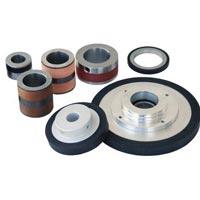
Rubber To Metal Bonded Part is a means by which rubber is mechanically bonded to a metal insert during the molding process. To begin the bonding process, the inserts are first prepped for production using a degreasing system to rid the parts of any contaminants before the adhesive is applied. Next, the heat activated adhesive is applied to the inserts using a technique similar to spray painting. Once the metals are prepared, they are ready for production.
The inserts are then physically placed, one at a time, into each cavity of the mold. For inserts on the top of a part, special magnets are incorporated into the mold to hold them in place while the mold is being loaded. Also, for inserts being encapsulated into the rubber, special chaplet pins are incorporated into the mold to suspend the insert in the mold & allow the rubber to flow around the metal.
Once the inserts are in place, the normal rubber molding process commences. After the mold is closed, and the molding begins, the adhesive on the metals is activated, allowing the inserts to bond to the rubber.
Typical applications for rubber to metal bonding include, any part requiring the combination of the flexibility of rubber and the stability of a metal. Components ranging in size from small mounts for motors to large locomotive suspension parts are just a sampling of parts produced using this process.
Rubber can be bonded with metal using more than 15 polymers including: Nitrile / Buna-N (NBR), Fluorocarbon (Viton®, Fluorocarbon (FKM), Silicone (VMQ), Fluorosilicone (FVMQ), Polyurethane (AU/EU), Natural Rubber (NR), Ethylene Propylene (EPDM), Hydrogenated Nitrile Rubber (HNBR), Styrene Butadiene Rubber (SBR), Chloroprene (Neoprene®), etc.
Rubber To Metal Bonded Part is a means by which rubber is mechanically bonded to a metal insert during the molding process. To begin the bonding process, the inserts are first prepped for production using a degreasing system to rid the parts of any contaminants before the adhesive is applied. Next, the heat activated adhesive is applied to the inserts using a technique similar to spray painting. Once the metals are prepared, they are ready for production.
The inserts are then physically placed, one at a time, into each cavity of the mold. For inserts on the top of a part, special magnets are incorporated into the mold to hold them in place while the mold is being loaded. Also, for inserts being encapsulated into the rubber, special chaplet pins are incorporated into the mold to suspend the insert in the mold & allow the rubber to flow around the metal.
Once the inserts are in place, the normal rubber molding process commences. After the mold is closed, and the molding begins, the adhesive on the metals is activated, allowing the inserts to bond to the rubber.
Typical applications for rubber to metal bonding include, any part requiring the combination of the flexibility of rubber and the stability of a metal. Components ranging in size from small mounts for motors to large locomotive suspension parts are just a sampling of parts produced using this process.
Rubber can be bonded with metal using more than 15 polymers including: Nitrile / Buna-N (NBR), Fluorocarbon (Viton®, Fluorocarbon (FKM), Silicone (VMQ), Fluorosilicone (FVMQ), Polyurethane (AU/EU), Natural Rubber (NR), Ethylene Propylene (EPDM), Hydrogenated Nitrile Rubber (HNBR), Styrene Butadiene Rubber (SBR), Chloroprene (Neoprene®), etc.
Silicone rubber has historically been used in specialty applications in order to meet requirements other elastomers cannot. Silicones have the largest application temperature span of all rubbers (-120 F to 500 F, with one or two exceptions where highly specialized and costly Fluoropolymers can compare).
Their chemical structure allows Silicones to be the most benign of all rubbers in medical applications (again, the exception are some very costly Fluoroelastomers). Cytotoxity tests of Silicone parts made with simple formulations show no adverse effects.
The US military applies the longest shelf life criteria to Silicone rubber components. For example, a coolant hose made with Silicone meeting SAE J20, is given a shelf life of 20 years, whereas those made with chloroprene rubber meeting SAE J20 are given a shelf life of 8 years.
The benign nature of this rubber makes components made with Silicone ideal for electronic applications, where long life and chemical inertness are essential to good electrical integrity over the component’s life. Silicone rubber parts can be made extremely conductive (resistivity of 0.0001Ω cm) or highly insulative (resistivity of 1015Ω cm).
In the automotive components market Silicone rubber has found major utilities in break line components, electrical grommets, radiator hoses, fuel line check valves (Fluorosilicone) and Oil Pan and Rocker Cover gaskets, as well as Spark Plug boots. It is estimated that in a modern car, 25% of the rubber components (excluding tires) are made of Silicone rubber
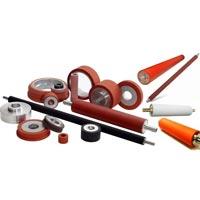
It is mostly used in Food packaging machinery, Conveyor belting industry, Electronic component manufacturing companies, PCB Panel manufacturing industry, etc.