Thank you for writing to us. One of our executive will reach back to you through your submitted medium. In case there’s an urgency, feel free to connect over WhatsApp for faster response.
Prefer calling? Dial +918048033839 (International callers) or 08048033839 (Indian callers).
Rubber To Metal Bonded Part is a means by which rubber is mechanically bonded to a metal insert during the molding process. To begin the bonding process, the inserts are first prepped for production using a degreasing system to rid the parts of any contaminants before the adhesive is applied. Next, the heat activated adhesive is applied to the inserts using a technique similar to spray painting. Once the metals are prepared, they are ready for production.
The inserts are then physically placed, one at a time, into each cavity of the mold. For inserts on the top of a part, special magnets are incorporated into the mold to hold them in place while the mold is being loaded. Also, for inserts being encapsulated into the rubber, special chaplet pins are incorporated into the mold to suspend the insert in the mold & allow the rubber to flow around the metal.
Once the inserts are in place, the normal rubber molding process commences. After the mold is closed, and the molding begins, the adhesive on the metals is activated, allowing the inserts to bond to the rubber.
Typical applications for rubber to metal bonding include, any part requiring the combination of the flexibility of rubber and the stability of a metal. Components ranging in size from small mounts for motors to large locomotive suspension parts are just a sampling of parts produced using this process.
Rubber can be bonded with metal using more than 15 polymers including: Nitrile / Buna-N (NBR), Fluorocarbon (Viton®, Fluorocarbon (FKM), Silicone (VMQ), Fluorosilicone (FVMQ), Polyurethane (AU/EU), Natural Rubber (NR), Ethylene Propylene (EPDM), Hydrogenated Nitrile Rubber (HNBR), Styrene Butadiene Rubber (SBR), Chloroprene (Neoprene®), etc.
Rail / Metro-Grade EPDM Rubber—EN45545 R23 HL3 Certified
Safety. Compliance. Performance. Delivered.
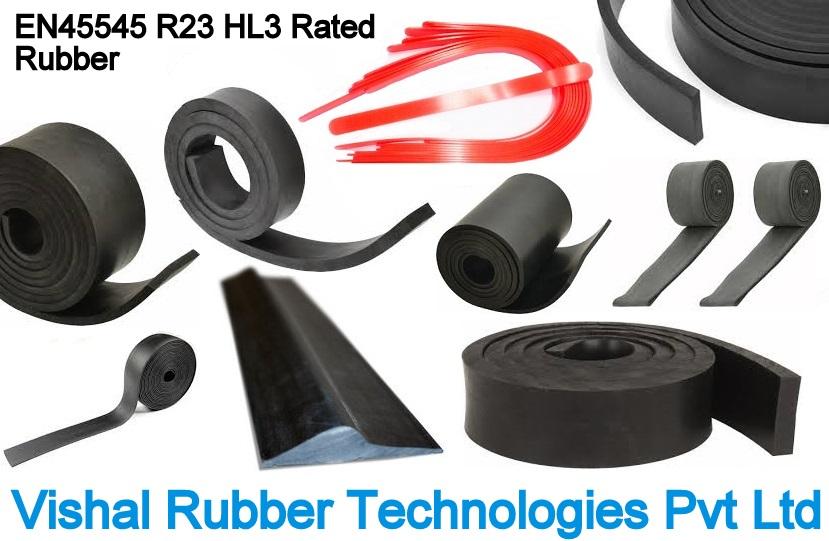
We proudly introduce our EN45545-2 R23 HL3-rated EPDM rubber solutions, engineered for the most demanding rail applications. Designed to meet the highest fire safety standards in Europe, our materials offer exceptional flame resistance, low smoke emission, and minimal toxicity—ensuring passenger protection and regulatory peace of mind.
Why Choose Our EPDM?
Certified to EN45545 HL3 for R23 sealing and gasketing applications
Halogen-free, low-smoke, and non-toxic—ideal for enclosed rail environments
Excellent weathering, ozone, and UV resistance for long-term durability
Wide operating range: -40°C to +120°C
Available in custom extrusions, Moulded Rubber Parts
Applications
Railcar/Metro
HVAC and cable entry gaskets
Anti-vibration mounts
Interior and exterior sealing systems
Global Compliance & Export Ready
Our EPDM compounds are backed by third-party fire testing. Whether you're supplying OEMs or retrofitting fleets, our materials are ready for global deployment.
Metal Inlay Flange Rubber Gaskets
Engineered for Reliability. Certified for Global Standards.
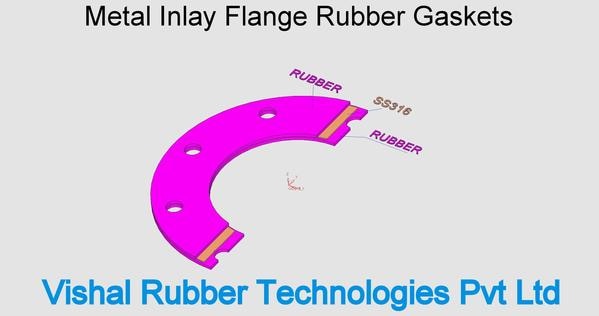
Our metal inlay flange rubber gaskets combine the resilience of high-grade elastomers with the structural integrity of precision-engineered steel inserts—delivering unmatched sealing performance across demanding industrial environments.
Key Features:
• Vulcanized Metal Core: Centrally embedded steel (SS304, SS316 etc) ensures blow-out safety and dimensional stability under extreme pressure and temperature.
• Elastomer Versatility: Available in EPDM, NBR, HNBR, FKM, and more—each tailored to resist steam, chemicals, hydrocarbons, and aggressive media.
• Low Surface Pressure Sealing: Achieves tight seals even at reduced bolt torque, minimizing flange stress and installation complexity.
• Wide Temperature Range: Operational reliability up to 200°C, ideal for pipelines, HVAC, chemical processing, and transit systems.
• EPDM variants available with EN45545 HL3 fire safety rating for rail applications.
Applications:
• Rail & Transit (EN45545 HL3-compliant)
• Oil & Gas, Petrochemical
• Power Plants & Industrial Equipment
• Drinking Water & Food-Grade Systems (material-specific)