A fire-retardant silicone O-ring is not made safe by adding a flame claim to a standard seal: the compound, moulding cycle, dimensions, installation and test evidence must work together. By the end, you will know how to specify the part, follow its manufacturing route and judge whether a supplier’s inspection records prove both sealing performance and flammability compliance.
Key takeaways
- Verify the weighed compound against the approved formulation and batch record.
- Treat UL 94 as a flammability test, not proof of sealing performance.
- Specify groove dimensions, compression, temperature, pressure and chemical exposure first.
- Check each lot for dimensions, hardness, defects, cure and traceability.
From weighed compound to finished O-ring: the manufacturing route
Fire resistant silicone oring production starts with a weighed formulation, not a colour choice. The batch record identifies the silicone polymer, cure system, pigment and flame-retardant additive, with each ingredient checked against its approved formulation.
- Weigh the polymer, filler, pigment and flame-retardant package, then record the compound batch numbers.
- Incorporate the additives on a two-roll mill or in an internal mixer until dispersion and viscosity meet the mixing specification.
- Sheet the compound to a controlled thickness and inspect it for unmixed particles, air pockets and contamination.
- Load measured charges into a clean mould containing the specified O-ring cavity, then compression-mould or transfer-mould at the validated temperature, pressure and cure time.
- Remove the moulded strip or individual rings, post-cure them when the formulation requires it, and control oven temperature, time and air circulation.
- Deflash the rings without cutting the sealing surface, then inspect the parting line, flash, nicks, voids and mould-fill defects.
Inspection continues beyond appearance. Verify compound identity, batch number, cure system, hardness, specific gravity and cure characteristics; use FTIR or another approved identification method for critical formulations. Measure dimensions and physical properties using an O-ring method such as ASTM D1414.
The purchase specification should state polymer type, cure system, hardness, colour, AS568 or other size standard, temperature and media exposure, UL 94 requirement, compression-set limit, dimensional tolerance, sampling plan and certificate contents. Flame-retardant additives can hinder mould filling and reduce elongation, tear strength or low-temperature flexibility, so qualify sealing performance alongside flammability.
Why the silicone formulation and moulding cycle control seal performance
A flame-retardant additive can make a silicone compound harder to process and easier to mis-specify. Higher viscosity restricts mould filling, while excessive filler loading can reduce elongation, tear strength, low-temperature flexibility and compression-set resistance. Platinum curing does not automatically provide flame retardancy; the complete formulation determines performance.
| Formulation or process change | Likely effect on the finished O-ring | Control to verify |
|---|---|---|
| Flame-retardant filler or additive | Better self-extinguishing behaviour, but possible loss of strength, flexibility or compression-set performance | Tensile strength, elongation, tear strength and compression set |
| Insufficient mould temperature, pressure or cure time | Under-cured rubber, poor strength, high compression set and reduced hot-air performance | Cure characteristics, part hardness and dimensional inspection |
| Correct post-cure for a peroxide system | Lower residual peroxide products and volatile matter, with better odour, compression set and high-temperature stability | Time and temperature record for the approved recipe |
Do not compensate for poor filling by changing settings without qualification. Cure temperature, mould temperature, pressure, injection speed and cycle time affect cure completeness, flash, dimensions and sealing force; fire-retardant grades can require different settings from standard silicone.
Check chemical compatibility alongside flame performance. ASTM D471 or ISO 1817 immersion testing should use the actual fluid, temperature, duration and specimen condition. For a purchase described as fire retardant silicone for oring manufacturing in pune, specify the cure system, hardness, compression-set limit, service temperature, media and test certificates—not colour or a generic flame claim.
What UL 94 proves—and what it does not prove
UL 94 ranks how a defined specimen ignites, burns and extinguishes under a laboratory flame. It does not prove that an O-ring will stay elastic, hold pressure or prevent leakage during a fire.
The classification also depends on specimen shape, orientation and thickness; a compound rated V-0 at 3.0 mm is not automatically V-0 at an O-ring’s thinner cross-section.
| Classification | Test meaning | Main acceptance difference |
|---|---|---|
| V-0 | Vertical specimen receives two 10-second flame applications | Total afterflame is limited to 50 seconds for five specimens; flaming drips must not ignite cotton |
| V-1 | Same vertical sequence | Total afterflame is limited to 250 seconds; flaming drips must not ignite cotton |
| V-2 | Same vertical sequence | Total afterflame is limited to 250 seconds; flaming drips may ignite cotton |
| 5VB | A 5V flame is applied to vertical bars and a horizontal plaque | The plaque may burn through, but flaming drips and the specified afterflame limits must be met |
| 5VA | Same 5V sequence | The plaque must not burn through; this is the more demanding plaque classification |
A UL 94 result describes flame-extinguishing behaviour, not resistance to heat, smoke, toxic combustion products or mechanical failure. A gasket exposed to fire faces compression loss, thermal expansion, pressure changes and chemical attack even if its compound passes V-0 or 5VA.
For a fire-safe valve, ask for application testing such as ISO 10497, which examines fire exposure, leakage and post-fire operability. Specify the UL 94 class, test method, specimen thickness and whether the result covers the compound or the finished O-ring.
Specify the groove, seal and service conditions before production
Set the groove and seal geometry before ordering a mould. Record the O-ring inside diameter, cross-section, tolerances and applicable size standard, such as ISO 3601, alongside the groove diameter, width, depth, corner radii and allowable extrusion gap.
| Specification | What to fix | Why it matters |
|---|---|---|
| Squeeze | Static or dynamic application and target radial or axial compression | Too little squeeze leaks; too much raises friction, heat and compression set |
| Stretch | O-ring inside-diameter stretch during installation | Excess stretch reduces cross-section and sealing force |
| Gland fill | Maximum rubber volume as a percentage of gland volume | Overfill leaves no room for thermal expansion |
| Pressure | Differential pressure, direction, cycling and extrusion gap | Pressure can force the seal into the clearance gap and cut it |
| Temperature | Continuous, peak, cycling and fire-exposure temperatures | Silicone softens, hardens or loses compression force outside its qualified range |
| Fluid | Exact oil, fuel, steam, air or chemical, including concentration and exposure duration | A generic compatibility claim cannot predict swelling or property loss |
State the installation method as well: assembly direction, mating-part chamfer, surface finish, lubricant type, allowable twist and whether the seal moves, rotates or remains static. A sharp edge can shave the sealing surface; twisting can create a leak path that passes dimensional inspection.
Specify the groove material, hardware tolerances and pressure-side backup arrangement before moulding. Then require the supplier to confirm gland fill, squeeze, stretch and extrusion risk from the final drawing, not from the nominal O-ring size alone.
How to check every lot and choose a credible supplier
Do not approve a lot because the O-rings look clean or the colour matches the sample. Release each lot against a written plan that links the compound batch, moulding date, cavity, cure and post-cure cycle, inspection results, nonconformance decision and retained samples.
Demand these records from the fire retardant silicone seals supplier:
- 100% visual and flash inspection, plus lot-based dimensional results for inside diameter, cross-section and specified tolerances, using ASTM D1414 methods where applicable.
- Hardness, tensile strength, elongation, compression set, specific gravity and cure data; a Shore hardness value alone is inadequate.
- Compound identity, cure system and batch number, supported by FTIR or another approved identification method when formulation control is critical.
- The exact UL 94 report, specimen thickness, conditioning and classification. Also request the application fire-test standard if the seal must remain leak-tight after heat or flame exposure.
- Chemical-compatibility results for your actual fluids, temperature and exposure time, including volume, mass, hardness and tensile changes.
| Record | Evidence to check | What a gap means |
|---|---|---|
| Dimensional | Method, sample size, readings and calibrated equipment | You cannot prove gland fit or isolate drift |
| Physical | Test date, specimen preparation and lot link | Hardness does not establish seal life |
| Flammability | Accredited report and exact material thickness | “Fire-resistant” is only a marketing claim |
| Chemical | Named fluid, temperature, duration and property changes | Compatibility was not demonstrated |
| Traceability | Batch, cavity, cycle, disposition and retained sample | A failed O-ring cannot be contained |
For silicone O-ring quality testing in Pune, verify that the laboratory’s ISO/IEC 17025 scope covers the method and material, and inspect its edition, uncertainty and equipment traceability. Vishal Rubber Technologies Pvt. Ltd. should be assessed by the same evidence, not by location or catalogue claims.
Related products
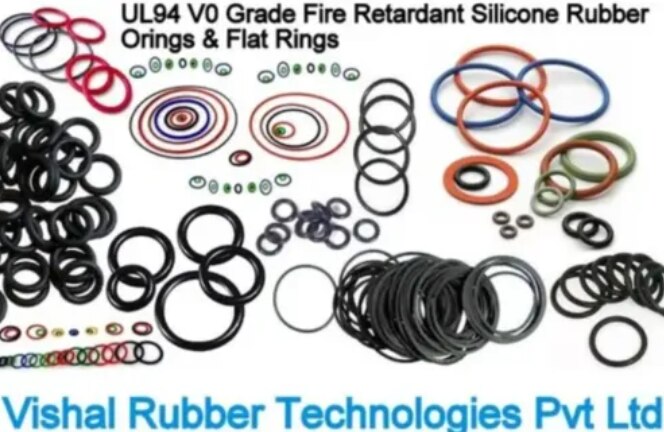
 | Rubber Fire Retardant Silicone Rubber Orings ₹20 We manufacture and Supply UL 94 Silicone Rubber Orings and Rubber Parts From Lowest (Least Flame - Retardant) to Highest (Most Flame - Retardant). View product → |
 | Fire Retardant Fire Retardant (FR) UL94 Silicone & EPDM Rubber Strips/Gaskets We manufacture and Supply UL 94 EPDM & Silicone Rubber Parts Like FR Strips, FR Grommets, FR Gaskets, FR Orings, FR Sleeves, FR Washers and other... View product → |
Frequently asked questions
How are fire resistant silicone O-rings manufactured?
Production moves from a weighed silicone formulation through mixing, calendaring or preforming, moulding, curing, flash removal, inspection and lot release. The batch record links each finished O-ring to its compound and moulding cycle.
What does UL 94 prove for a fire retardant silicone O-ring?
UL 94 classifies how a material behaves in a specified vertical or horizontal flammability test. It does not prove leak prevention, compression-set resistance, temperature life, chemical compatibility or performance in a particular fire scenario.
What information should you provide before ordering silicone O-rings?
Provide the groove dimensions, O-ring size, target compression, pressure, temperature range, motion, fluid exposure, fire requirement and installation conditions. These details determine the compound, hardness and seal design.
How do you check the quality of a silicone O-ring lot?
Review the certificate and batch traceability, then check dimensions, hardness, surface defects, flash, cure and required material or flammability test results. Compare samples with the approved drawing and specification.
Related product
 | Fire Retardant Fire Retardant FR EPDM & Silicone Rubber Products We manufacture and Supply UL 94 EPDM & Silicone Rubber Parts Like FR Grommets, FR Gaskets, FR Orings, FR Sleeves, FR Washers and other moulded or... View product → |