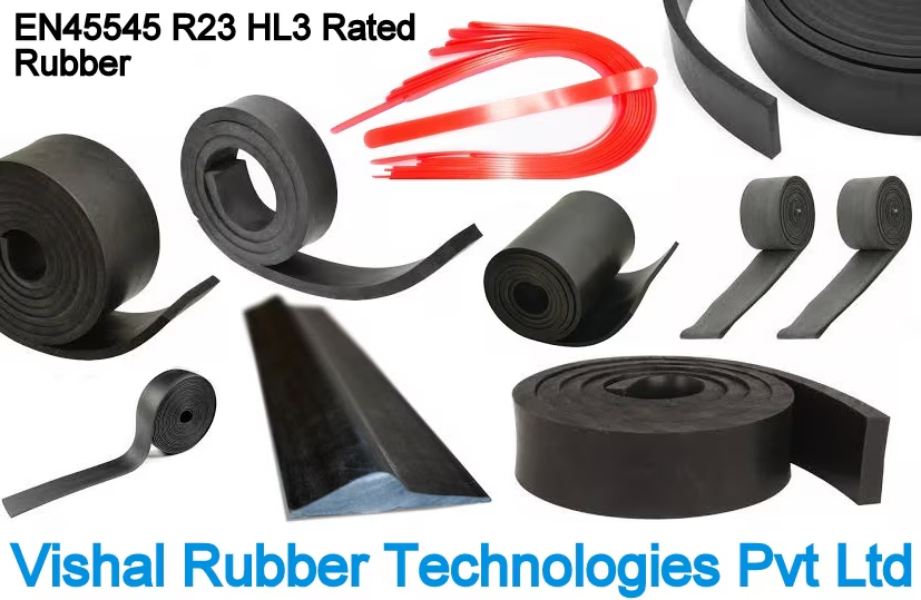
Railway rubber components must perform reliably while meeting demanding fire-safety requirements. Vishal Rubber Technologies manufactures EN45545 HL3 rated EPDM rubber products for railway equipment manufacturers, coach builders and engineering companies in Pune. Selection should be based on the component’s intended location, operating environment and applicable fire-performance requirements.
EN 45545 is a European railway standard covering fire protection on railway vehicles. EN 45545-2 focuses on the fire behaviour of materials and components. It classifies products through requirement sets and hazard levels determined by the vehicle category, operating category and intended use.
HL3 represents the most demanding hazard level within the standard. However, describing a material simply as “HL3 rubber” is not sufficient. Compliance must be linked to the relevant requirement set, test method, sample thickness and end-use application.
Why EPDM Is Used in Railway Components
EPDM rubber provides a practical combination of flexibility, weather resistance and resistance to ozone and environmental ageing. These characteristics make it suitable for many exterior and interior railway sealing applications.
Depending on its formulation and test status, EPDM may be considered for:
- Railway door and window profiles
- Coach body sealing sections
- Equipment enclosure gaskets
- HVAC system seals
- Cable-entry components
- Anti-vibration pads
- Roof and exterior sealing profiles
- Electrical cabinet seals
- Panel and partition gaskets
Standard commercial EPDM should not automatically be used where EN 45545 compliance is specified. Fire-retardant compounds require controlled formulations intended to achieve particular flame-spread, smoke-density and toxicity performance under defined test conditions.
Details Buyers Should Confirm
Railway procurement teams should begin by identifying the requirement set mentioned in the project specification. The component’s mass, dimensions, location and exposed surface area may influence how it is classified.
Important details include:
- Applicable EN 45545-2 requirement set
- Required hazard level
- Tested material thickness
- Product shape and intended installation
- Interior or exterior placement
- Operating temperature range
- Exposure to water, cleaning agents and weather
- Required hardness and mechanical properties
- Colour and surface-finish requirements
- Documentation expected during inspection
A test report for a particular material thickness may not automatically cover every thickness or product configuration. Buyers should compare the proposed component with the conditions documented in the test evidence.
Balancing Fire Performance and Functional Performance
Fire behaviour is essential, but the product must also perform its sealing or cushioning function. Excessively hard rubber may not compress properly. A very soft compound may deform under sustained load. A profile with unsuitable geometry may create installation difficulties even when the material itself meets the stated fire requirement.
Engineering evaluation should therefore consider:
- Compression and recovery
- Tensile strength and elongation
- Resistance to ozone and weathering
- Dimensional tolerances
- Adhesion requirements
- Service temperature
- Repeated movement
- Contact with oils and chemicals
Prototype sampling can help verify fitment before volume production. For extruded profiles, checking the joining method and corner construction is also important.
Railway Manufacturing Requirements in Pune
Pune and the wider Maharashtra engineering belt support railway, metro, automotive and specialised transport manufacturing. Local access to technical discussions, samples and dimensional evaluation can simplify development for manufacturers working to controlled project specifications.
Vishal Rubber Technologies can review drawings and application details for EN45545 HL3 rated EPDM rubber products. Buyers should provide the exact requirement set and supporting project criteria at the enquiry stage instead of relying on a general fire-retardant description.
Correct specification protects both compliance and functionality. A suitable railway rubber component must align with the required fire test classification while maintaining the sealing, insulation or vibration-control performance expected throughout its intended service conditions.