Thank you for writing to us. One of our executive will reach back to you through your submitted medium. In case there’s an urgency, feel free to connect over WhatsApp for faster response.
Prefer calling? Dial +918048033839 (International callers) or 08048033839 (Indian callers).
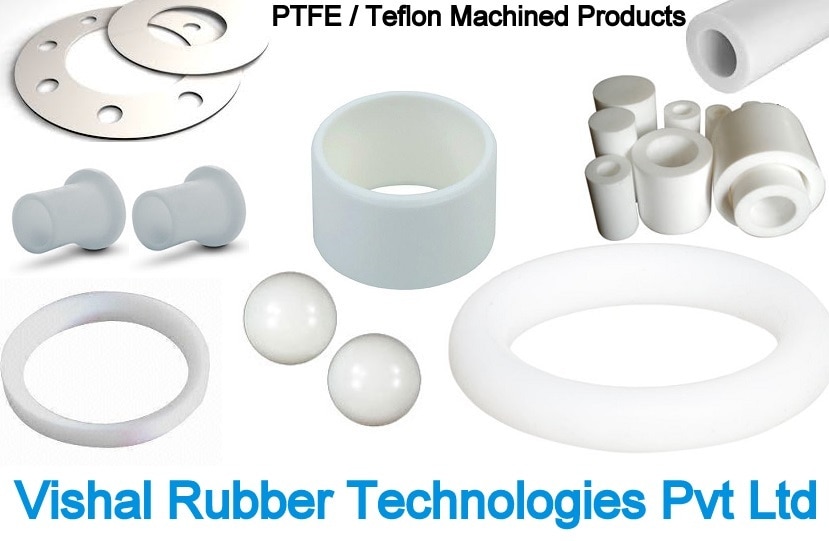
We are offering ptfe machined products. Vishal Rubber Technologies Pvt Ltd is leading Manufacturer, Exporter & Supplier of PTFE machined components in various sizes and materials used in various applications of Sealing, non-abrasive applications, chemicals plants, high temperature applications etc.
Rubber To Metal Bonded Part is a means by which rubber is mechanically bonded to a metal insert during the molding process. To begin the bonding process, the inserts are first prepped for production using a degreasing system to rid the parts of any contaminants before the adhesive is applied. Next, the heat activated adhesive is applied to the inserts using a technique similar to spray painting. Once the metals are prepared, they are ready for production.
The inserts are then physically placed, one at a time, into each cavity of the mold. For inserts on the top of a part, special magnets are incorporated into the mold to hold them in place while the mold is being loaded. Also, for inserts being encapsulated into the rubber, special chaplet pins are incorporated into the mold to suspend the insert in the mold & allow the rubber to flow around the metal.
Once the inserts are in place, the normal rubber molding process commences. After the mold is closed, and the molding begins, the adhesive on the metals is activated, allowing the inserts to bond to the rubber.
Typical applications for rubber to metal bonding include, any part requiring the combination of the flexibility of rubber and the stability of a metal. Components ranging in size from small mounts for motors to large locomotive suspension parts are just a sampling of parts produced using this process.
Rubber can be bonded with metal using more than 15 polymers including: Nitrile / Buna-N (NBR), Fluorocarbon (Viton®, Fluorocarbon (FKM), Silicone (VMQ), Fluorosilicone (FVMQ), Polyurethane (AU/EU), Natural Rubber (NR), Ethylene Propylene (EPDM), Hydrogenated Nitrile Rubber (HNBR), Styrene Butadiene Rubber (SBR), Chloroprene (Neoprene®), etc.
We manufacture and Supply UL 94 EPDM Rubber Belts, Rubber Gaskets, Rubber Sheets and Rubber Strips as per customer requirements
From Lowest (Least Flame - Retardant) to Highest (Most Flame - Retardant).
Standards are given below for details about its details of testing,
UL 94-5VA
UL 94-5VB
UL 94 V-0
UL 94 V-1
UL 94 V-2
UL 94 H-B
HB: slow burning on a horizontal specimen; burning rate < 76 mm/min for thickness < 3 mm or burning stops before 100 mm
V-2: burning stops within 30 seconds on a vertical specimen; drips of flaming particles are allowed.
V-1: burning stops within 30 seconds on a vertical specimen; drips of particles allowed as long as they are not inflamed.
V-0: burning stops within 10 seconds on a vertical specimen; drips of particles allowed as long as they are not inflamed.
5VB: burning stops within 60 seconds on a vertical specimen; no drips allowed; plaque specimens may develop a hole.
5VA: burning stops within 60 seconds on a vertical specimen; no drips allowed; plaque specimens may not develop a hole.
PTFE Sheets are typically of two types, namely Skewed PTFE Sheets and Moulded PTFE Sheets. Widely used in applications where high abrasion resistance is required, chemical resistance, high heat resistance, Oil & Acid resitance, etc.
PTFE is principally used as a gasket material because of it's capability to remain unaffected by the majority of chemicals used in industry. It is also classified, in most cases, as a food grade material, making it acceptable to both medical and food production industries. There are three basic types of PTFE gasket materials. Virgin PTFE , filled PTFE and expanded PTFE .
Virgin PTFE is by far the least expensive of the three varieties, and is used in most general applications. Filled PTFE is a gasket material with a virgin PTFE base to which a substance is added during manufacture to improve the sealing characteristics of PTFE . This “filler“ usually is glass or graphite particles although ceramics has sometimes been used. The resulting gasket material is strong, yet highly compressible with very good, though not universal, chemical resistance.
Expanded PTFE is virgin PTFE to which a stress resistance has been added by means of molecular rearrangement during manufacture. This process ensures that the molecular chains from which the PTFE is constructed, do not arrange themselves into set patterns. This means that expanded PTFE possesses no structural weakness (grain) and expands and contracts equally in all directions. Because no additives are required, expanded PTFE also possesses the unique chemical resistance of virgin PTFE .
PTFE is principally used as a gasket material because of it's capability to remain unaffected by the majority of chemicals used in industry. It is also classified, in most cases, as a food grade material, making it acceptable to both medical and food production industries. There are three basic types of PTFE gasket materials-Virgin PTFE, Filled PTFE and expanded PTFE.
Virgin PTFE is by far the least expensive of the three varieties, and is used in most general applications. Filled PTFE is a gasket material with a virgin PTFE base to which a substance is added during manufacture to improve the sealing characteristics of PTFE. This “filler“ usually is glass or graphite particles although ceramics has sometimes been used. The resulting gasket material is strong, yet highly compressible with very good, though not universal, chemical resistance.
Expanded PTFE is virgin PTFE to which a stress resistance has been added by means of molecular rearrangement during manufacture. This process ensures that the molecular chains from which the PTFE is constructed, do not arrange themselves into set patterns. This means that expanded PTFE possesses no structural weakness (grain) and expands and contracts equally in all directions. Because no additives are required, expanded PTFE also possesses the unique chemical resistance of virgin PTFE.
We manufacture and Supply UL 94 EPDM & Silicone Rubber Parts Like FR Grommets, FR Gaskets, FR Orings, FR Sleeves, FR Washers and other moulded or extruded Rubber products.
From Lowest (Least Flame - Retardant) to Highest (Most Flame - Retardant).
Standards are given below for details about its details of testing,
UL 94-5VA
UL 94-5VB
UL 94 V-0
UL 94 V-1
UL 94 V-2
UL 94 H-B
HB: slow burning on a horizontal specimen; burning rate < 76 mm/min for thickness < 3 mm or burning stops before 100 mm
V-2: burning stops within 30 seconds on a vertical specimen; drips of flaming particles are allowed.
V-1: burning stops within 30 seconds on a vertical specimen; drips of particles allowed as long as they are not inflamed.
V-0: burning stops within 10 seconds on a vertical specimen; drips of particles allowed as long as they are not inflamed.
5VB: burning stops within 60 seconds on a vertical specimen; no drips allowed; plaque specimens may develop a hole.
5VA: burning stops within 60 seconds on a vertical specimen; no drips allowed; plaque specimens may not develop a hole.
We are engaged in offering qualitative range of Rubber Metal Bonded Product to our clients. The rubber bonded is widely used for the isolation of noise and vibration in automotive and engineering applications. Furthermore, these products are available at reasonable market rates and also customized as per the precise requirements of our worldwide clients.
Features:
Accurate dimension
Durable
High tensile strength
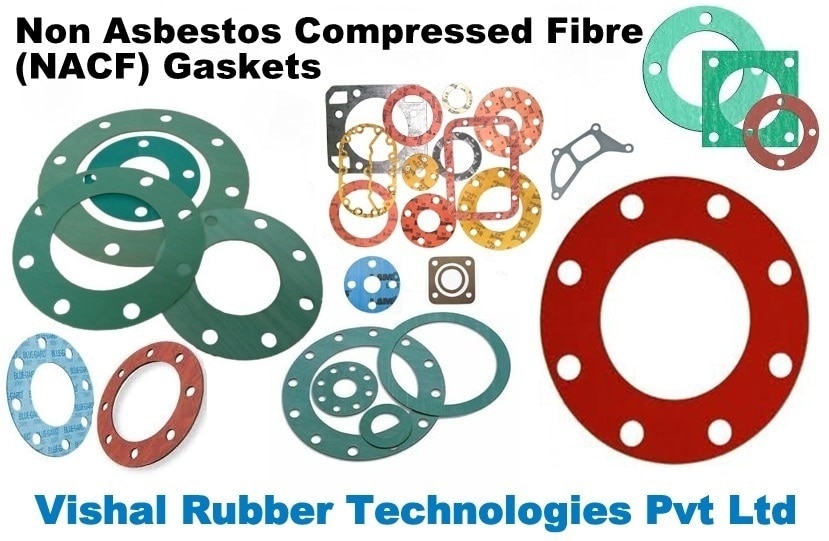
NACF Gaskets
Non-asbestos fiber mixed with heat/chemical resisting rubber binder, then rolled and vulcanized. Used as pipe flange and gasket for equipment in various industries.
EPDM Rubber Gaskets for Solar Water Heater Panels used for 1 inch pipelines as per BIS no. IS12933(Part II) for thermal shock test.
Type of Gaskets:
1. Blind Rubber Gasket
2. Flange Rubber Gasket
3. Tapered Flange Rubber Gasket