Choosing a vibration-control mount requires more than matching a part by outside diameter or Shore hardness. By the end, you will be able to calculate mount loads, match stiffness to machine excitation, select the right bonded geometry, and write a purchase specification that can be tested and traced.
Key takeaways
- Calculate static and dynamic load per mount before selecting rubber stiffness.
- Keep mount natural frequency below the machine’s excitation frequency.
- Specify geometry, insert material, rubber compound and service exposure.
- Approve suppliers with functional deflection and rubber-to-metal bond tests.
How a bonded rubber mount controls machine movement
A bonded mount isolates vibration only when its stiffness and damping suit the machine’s excitation. Low stiffness permits controlled deflection, shifting the mount’s natural frequency below the operating frequency; this reduces vibration transmitted into the foundation. High stiffness restrains movement but passes more force into the structure.
- Stiffness sets resistance in each load direction. A mount can be soft in shear and firm in compression, so use data for the actual direction rather than a single hardness value.
- Damping limits resonance and reduces overshoot after start-up, stopping or shock. Excessive damping can increase force transmission at higher frequencies.
- Preload keeps the rubber in contact and establishes its working position. Too little preload permits lift-off or rattling; too much preload changes stiffness and consumes available deflection.
- Deflection is the movement under static and dynamic load. Allowable deflection must cover operating motion without bottoming, tearing or permanent set.
- Load direction determines strain. A mount designed for compression can fail when rotation, lateral shear or tensile pull is added.
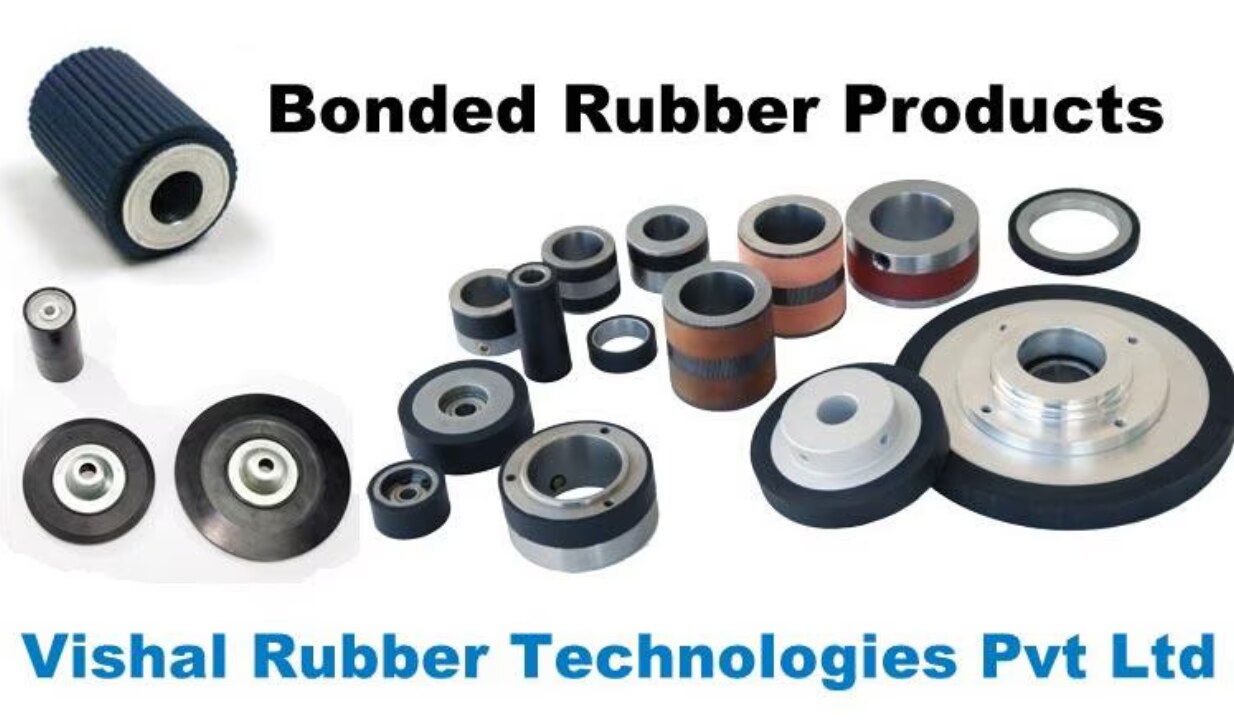
Industrial rubber bonded components therefore need stiffness and damping data at the machine’s frequency, amplitude, temperature and preload. A mount intended for isolation accepts limited movement; a restraint or resilient stop uses higher stiffness and controlled travel to limit movement.
In metal bonded rubber applications, check combined compression, shear and rotation rather than approving the part from outside dimensions alone.
Calculate mount load and check resonance before choosing a compound
Convert operating speed to excitation frequency: f = RPM/60. Calculate supported weight W = mass × 9.81, then determine each mount’s static reaction from the centre-of-gravity position; W divided by mount count is valid only when reactions are equal. An off-centre machine creates different reactions and overturning moments.
- Select the total stiffness from the required natural frequency: ktotal = (2πfn)²M. For n identical mounts, use k per mount = ktotal/n, then check static deflection δ = load per mount/k. Excessive deflection causes movement; insufficient deflection leaves the natural frequency too close to running speed.
- Keep fn below the lowest disturbing frequency, and calculate the frequency ratio r = f/fn. Estimate transmissibility with T = √[1 + (2ζr)²] / √[(1 − r²)² + (2ζr)²], then compare T with your allowable vibration transmission. Test near startup, shutdown and any blade-pass, gear-mesh or reciprocating-force frequency.
- Resolve forces into vertical, horizontal and torsional directions. A mount that works in compression can be too soft in shear or fail under combined shear, compression and rotation.
| Direction | What to calculate | What to verify |
|---|---|---|
| Vertical | Compression stiffness, load and deflection | Static height and vertical transmissibility |
| Horizontal | Shear stiffness and lateral displacement | Side-load stability at operating RPM |
| Torsional | Rotational stiffness and torque reaction | Angular movement and insert fatigue |
Specify metal bonded rubber products for industrial machinery in Pune by dynamic stiffness at the operating frequency, not hardness alone. Compare rubber metal bonded parts for machinery using the actual load spectrum, temperature and required service life.
Choose the geometry, insert and alternative isolation method
Choose compression for predominantly vertical axial loads and short, controlled deflection. Choose shear for lateral isolation where the rubber can deform sideways without buckling. Use shear-compression when a mount carries vertical weight while absorbing lateral movement, rotation or torque; check combined strain, because a mount adequate in compression can tear under added shear.
A bonded steel sleeve, plate or threaded insert gives a defined load path and bolt location. Use a captive design when a failed bond must not release the machine, or when shock, lift-off and over-travel are credible hazards.
Metal bonded rubber components in Pune should be matched to the failure load, not selected by outside dimensions.
| Option | What it does | When it applies |
|---|---|---|
| Compression bonded mount | Carries axial load through rubber thickness | Vertical machinery loads with limited lateral travel |
| Shear bonded mount | Isolates movement across the rubber layer | Horizontal vibration and moderate displacement |
| Shear-compression mount | Combines vertical support with lateral compliance | Machines with offset centres of gravity or torque |
| Captive bonded mount | Adds mechanical retention beyond the adhesive bond | Shock loads, lift-off risk or safety-critical restraint |
| Plain rubber pad | Provides simple compression damping and leveling | Low-cost, low-precision support with small movement |
| Spring mount | Provides large deflection and low natural frequency | Heavy equipment requiring low-frequency isolation |
| Polyurethane mount | Offers a tougher, higher-load elastomer option | Abrasion, oil exposure or high wear demands after compatibility checks |
| Elastomeric bearing | Accommodates large load and rotation | Structural or foundation movement |
| Wire-rope isolator | Handles shock and harsh temperature exposure | Military, outdoor or fluid-sensitive environments |
For metal bonded rubber applications, select the alternative only after comparing allowable displacement, static load, shock, temperature and service life. A plain pad cannot replace a captive restraint, and a spring mount needs separate control of rebound and lateral movement.
Write a specification that covers materials, dimensions and service exposure
A drawing that states “60 Shore A” and the outside diameter does not define industrial rubber bonded components. Two compounds at that hardness can have different fatigue life, compression set, oil resistance, damping and low-temperature flexibility.
Put these fields on the drawing and purchase order:
- Rubber compound: polymer type, hardness range, tensile and elongation limits, compression-set requirement, dynamic stiffness, damping, colour, and permissible strain.
- Metal insert: grade, thickness, hardness, corrosion protection, surface finish, burr limit, concentricity, and insertion location.
- Adhesive system: primer and bonding agent identification, approved surface preparation, and compatibility with the specified rubber and insert finish.
- Cure cycle: mould temperature, pressure, cure time, post-cure requirement, and the recorded process limits.
- Geometry: bolt pattern, hole diameter, pitch-circle or centre-to-centre dimensions, loaded height, free height, insert position, and datum references.
- Tolerances: rubber dimensions, metal position, parallelism, concentricity, loaded height, and bolt-hole location.
- Service exposure: static and dynamic load, allowable displacement, frequency, shock, operating temperature range, fluids, ozone, weathering and required service life.
Do not accept rubber metal bonded parts for machinery by outside dimensions alone. Verify compression, shear, rotation and combined loading in the machine’s operating frequency range.
For approval, require hardness, dimensions, insert placement, bond-interface inspection, and rubber-to-metal adhesion testing to ASTM D429. Check fluid and temperature effects against the actual media; use ISO 1817 for rubber-fluid exposure and ASTM D395 or ISO 815-1 for compression set. Request batch records linking compound, metal preparation, adhesive lot, cure parameters and inspection results.
Approve a Pune supplier through functional and bond-interface testing
Approve a Pune supplier only after the prototype and production evidence pass the same agreed criteria. Compare metal bonded rubber components in Pune by bond integrity, compound behaviour, dynamic performance, dimensions and traceability—not by outside dimensions alone.
For metal bonded rubber products for industrial machinery in Pune, changing the rubber, metal grade, adhesive system or cure cycle can change durability without changing the drawing.
- Inspect rubber hardness, insert position, bond-line coverage, flash, voids, cracks and critical mounting faces. Set dimensional limits using ISO 3302-1, with separate tolerances for bolt holes, loaded height and bond locations.
- Request ASTM D429 rubber-to-metal adhesion results for the specified insert, adhesive and cure process. Reject unexplained interface separation, and require the supplier to state the method and failure description.
- Compare ISO 1817 immersion results after exposure to the actual oil, hydraulic fluid, coolant, cleaner, water or ozone environment. Review volume, mass, hardness and adhesion changes.
- Compare ASTM D395 or ISO 815-1 compression-set data at the specified temperature and duration. Treat it as compound-comparison evidence, not a direct service-life prediction.
- Run stiffness or transmissibility tests in the machine’s load direction, frequency range and preload. Ask Vishal Rubber Technologies Pvt. Ltd. for the same evidence when comparing its components with another Pune source.
| Test or record | What to compare | Approval evidence |
|---|---|---|
| Bond interface | ASTM D429 result and failure mode | Agreed adhesion limit |
| Media resistance | ISO 1817 property changes | No unacceptable swelling or softening |
| Function | Stiffness, damping or transmissibility | Meets design curve |
| Production control | Compound, metal, adhesive and cure batch records | Part-to-batch traceability |
Related products
 | Rubber We are engaged in offering qualitative range of Rubber Metal Bonded Product to our clients. View product → |
 | Metal Bonded Rubber Anti-Vibration (AV) rubber mounts or Isolators are crucial components in most types of heavy machinery and equipment which help dampen noise levels... View product → |
Frequently asked questions
How does a bonded rubber mount control machine movement?
Its stiffness limits movement while damping dissipates vibration. Lower stiffness allows deflection and can reduce transmission when natural frequency stays below excitation frequency.
How do you calculate bonded mount load and check resonance?
Divide supported machine weight by the number of mounts, then account for uneven loading, dynamic forces and preload. Compare the mount’s natural frequency with operating speed and excitation frequency.
What should you include when specifying a metal bonded rubber component?
State geometry, dimensions, rubber compound, insert material, hardness, load range, deflection limits, temperature, chemicals, ozone, water exposure and bond-interface requirements.
How can you approve a Pune supplier of bonded rubber parts?
Request material and dimensional records, then test static deflection, load capacity, damping and rubber-to-metal bond integrity on production samples.
Related product
 | We offer different types of Industrial Rubber Gaskets used according to purpose and type. View product → |