A replacement sleeve is easy to order badly: the shaft diameter alone cannot establish fit, service life or material compatibility. By the end, you will have a measurement checklist, a compound-selection method, an installation procedure and a quotation brief you can send to a Pune supplier.
Key takeaways
- Record bore, outside diameter, length, wall thickness and operating temperature.
- Choose rubber compound by fluid, temperature, abrasion and electrical exposure.
- Reject a rubber sleeve when heat, chemicals or pressure exceed its limits.
- Compare Pune quotations using drawings, compound details, tolerances and test reports.
What a rubber sleeve does during maintenance work
A rubber sleeve is a replaceable interface: it transmits motion, protects a surface, cushions contact or blocks contamination during shaft, coupling, cable, pipe and component repairs. Identify the job before searching for rubber sleeves for maintenance teams in Pune.
1. A coupling sleeve fits between hubs and transmits torque and rotation while tolerating small misalignment. It usually requires coupling disassembly; a split version clamps around the shaft when removing the hub is impossible.
2. A protective sleeve slides over a shaft, hose or pipe to shield it from impact, dirt, heat or fluid contact. A wear sleeve takes the abrasion instead of the component surface. Check the insertion path and whether shoulders, flanges or fittings mean the part must be removed first.
3. A cable grommet sits at an entry hole and protects insulation from a sharp edge; it does not repair damaged insulation. A buffer absorbs contact between parts, while a flexible bellows accommodates movement and keeps dust, water or other contaminants out.
The fit determines the replacement: a solid sleeve slides over a shaft, a split sleeve clamps around it, and an integrated coupling or bellows often requires disassembly. Do not treat every rubber sleeve as a mechanical seal, pressure-rated hose or flexible bellows.
A sleeve may lack the lip geometry, reinforcement, pressure rating or movement capacity those products require.
Before ordering, record whether the part is carrying torque, preventing abrasion, protecting insulation, cushioning impact or containing contamination. That single distinction eliminates many wrong replacements.
Measure the existing sleeve and write a usable specification
1. Measure the assembly, not just the replacement. Record the shaft or pin outside diameter, existing sleeve inside diameter, outside diameter, wall thickness, free length and installed length. Measure at several points because wear, swelling or ovality can make one reading misleading.
2. Record every feature that affects installation: keyways, shoulders, grooves, threads, retaining lips, holes, split lines and end profiles. Take photographs with a scale, mark the orientation, and provide a controlled sample when possible. A drawing for custom rubber sleeves in Pune should identify these features rather than rely on a catalogue image.
3. Write the service specification beside the dimensions. State the application, elastomer or compound, hardness, operating-temperature range, exposed fluids and whether the sleeve is static, sliding, protective or electrically insulating.
Specify tolerances, not nominal dimensions alone; discuss ISO 3302-1 with the supplier and identify whether it applies to the inside diameter, outside diameter, wall thickness and length.
4. Confirm the fit before ordering. Calculate assembly clearance or interference, required stretch over the shaft, and diameter change from thermal expansion at operating temperature. A nominal shaft diameter cannot determine fit by itself: the sleeve may wrinkle, drag, split during stretching or loosen when heated.
5. Check the job physically before releasing the order. Confirm whether the sleeve slides over the shaft, clamps around it or requires disassembly; then verify disassembly access, the insertion path and tool clearance. Record the findings with the drawing, photographs and sample so the quoted part can be inspected against one controlled specification.
Choose the compound—and know when rubber is the wrong material
Match the compound to the fluid, heat, movement and exposure—not to the word “rubber.”
| Compound | Best fit | Main warning |
|---|---|---|
| NBR | Mineral oil, grease and hydraulic fluids | Weak under strong weathering or ozone |
| EPDM | Hot water, steam, ozone and sunlight | Petroleum oils can cause swelling and failure |
| Silicone | Broad temperature service | Poorer abrasion, tear and high-load dynamic performance |
| Neoprene | Balanced weathering and moderate oil exposure | Verify the specific fluid and temperature |
| NR | High elasticity and abrasion in suitable environments | Avoid aggressive oils and ozone |
| FKM or Viton | Higher temperature and broader chemical resistance | Limits vary by grade |
Check the actual fluid, concentration, temperature and exposure time against data related to ASTM D471 or ISO 1817. Review volume or mass change, hardness change, tensile retention, softening and visible cracking; a generic material label cannot predict service life.
For a static seal, request compression-set data under ISO 815-1 with test temperature, duration and specimen details. For an insulating sleeve, request electrical test data, not hardness alone.
Choose metal where heat, heavy load or cutting risk dominates; PTFE for chemical resistance and low friction; polyurethane for abrasion; and heat-shrink tubing for cable repair. Use a split sleeve when disassembly is impossible, but specify a mechanical seal for pressurised rotating-fluid containment.
Before comparing rubber sleeve price in pune, confirm the compound and test evidence. A low quote for the wrong material costs more than a correctly specified sleeve.
Install the replacement without damaging it
Start with lockout and verify zero energy before touching the assembly. This procedure applies to rubber sleeves for maintenance teams in Pune and elsewhere.
1. Remove burrs, rust flakes and sharp edges. Inspect the shaft, bore, keyway and shoulder for scoring, raised metal, threads or damage that could cut the sleeve.
2. Clean the parts with a method compatible with the rubber compound. Confirm that the assembly lubricant is compatible with both the rubber and the service fluid; an unsuitable oil can swell, soften or crack the sleeve.
3. Fit a chamfer or edge protector at the entry. Use an installation mandrel, cone or rounded guide. Do not use screwdrivers or sharp hooks.
4. Align the sleeve with the shaft or bore, support it close to the insertion point and push it straight. Avoid twisting, limit stretching to the specified amount, and cover threads, keyways and gritty surfaces so they cannot cut the bore.
5. Release trapped air where the design permits. Check that grooves and lips are fully seated, then move the assembly by hand to confirm free movement without wrinkles, pinching or excessive drag.
6. Before removing the lockout, inspect every exposed edge for cuts, whitening from overstretching, rolled edges and displaced retaining features. Correct the installation before returning the equipment to service.
Compare Pune quotations by evidence, not by piece price
Compare a rubber sleeve price in Pune as a complete quotation, not as a low piece price detached from specification and evidence.
| Cost line | Ask the supplier to show | Why it matters |
|---|---|---|
| Tooling | Mould or die charge separately | Complex ends, grooves or inserts raise one-time cost |
| Approval | First-article or sample-approval charge | Confirms fit before production |
| Production | Recurring piece price and minimum quantity | Shows the real repeat-order cost |
| Quality and delivery | Testing, packaging and freight separately | Prevents hidden charges and weak comparisons |
Send a dimensioned drawing or controlled sample. For custom rubber sleeves in Pune, require the drawing to state compound designation, hardness, ID, OD, wall thickness, length, parting line, flash limit and every tolerance. Discuss ISO 3302-1 and identify whether its tolerance class applies to ID, OD, wall thickness and length.
Ask an industrial rubber sleeves supplier in Pune for these records:
- Batch traceability or a compound certificate
- Dimensional inspection records
- Test methods and test conditions
- Sample approval documents
- The policy for nonconforming parts, including replacement or concession handling
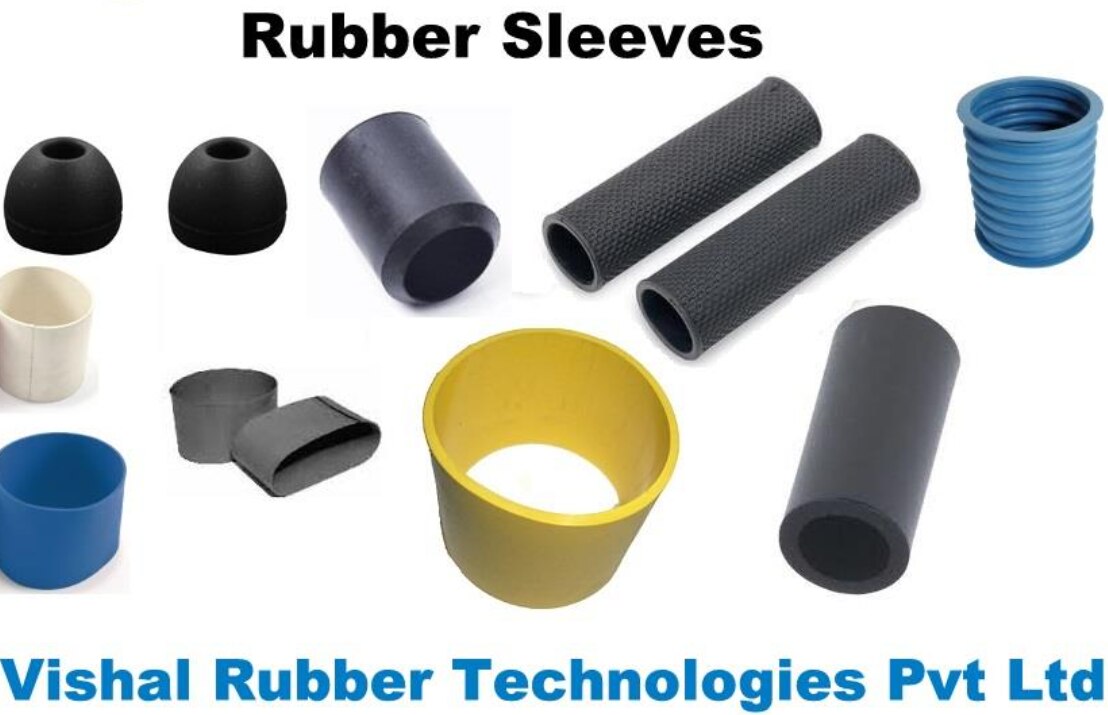
Compound, tooling, inserts, tolerance, order volume and testing usually move the price more than the word rubber. Vishal Rubber Technologies Pvt. Ltd. is one Pune option for a drawing-led discussion about rubber and polymer components, but a catalogue photograph or generic per-piece listing proves neither fit nor compliance.
Frequently asked questions
What measurements define a replacement rubber sleeve?
Record the existing sleeve’s bore, outside diameter, length and wall thickness. Also document shaft size, fit, operating temperature, movement, fluid exposure and required tolerances.
How do you choose the right rubber compound for a sleeve?
Match the compound to temperature, oils, fuels, water, chemicals, abrasion, ozone and electrical requirements. Use NBR for many oil-contact jobs, EPDM for hot water and weather exposure, and FKM when higher chemical and temperature resistance is required.
When is rubber the wrong material for a sleeve?
Choose another material when the application exceeds rubber’s temperature, chemical, pressure or wear limits. PTFE, polyurethane, metal or a composite construction may suit severe service better.
How should you install a replacement rubber sleeve?
Deburr and clean the mating surfaces, confirm orientation and dimensions, use a compatible lubricant when permitted, and avoid stretching, twisting, sharp tools and excessive force during installation.