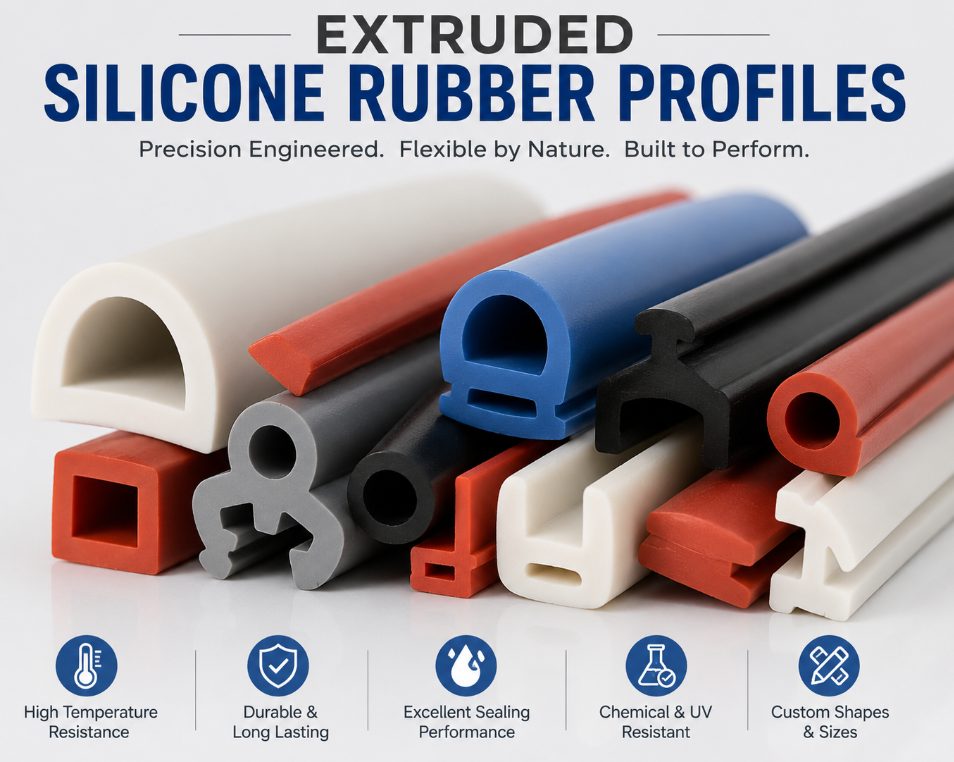
Extruded Silicone Rubber Profiles are used when manufacturers need continuous elastomer sections with a consistent cross-sectional shape.
They can serve as seals, edge profiles, protective sections, cushioning components, equipment interfaces across industrial applications.
For OEM manufacturers in Pune, Maharashtra, sourcing the correct profile requires more information than sending a rough sketch plus required length.
Understand the Extrusion Process
Extrusion creates a continuous profile by forcing uncured material through a die shaped to the required cross-section. The profile is subsequently cured through the appropriate manufacturing process.
This production method is useful for components that maintain the same cross-section across their length.
Common geometries can include
Solid rectangular sections
Round cords
Hollow sections
Channels
Bulb profiles
Complex custom sections
The final design should be suitable for consistent extrusion.
Define the Cross-Section Clearly
A dimensioned drawing is one of the most useful documents a buyer can provide.
The drawing should show critical dimensions, wall thicknesses, internal cavities, radii, tolerance expectations.
Small dimensional differences can affect compression plus fitment, particularly when the profile sits inside a groove.
For replacement components, supplying a worn sample without a drawing may not provide enough information because the original shape may already have changed through service.
Select Hardness According to Function
Hardness influences how the profile behaves during installation plus compression.
A softer profile may conform more easily to irregular surfaces. A firmer profile may provide greater resistance to deformation.
The correct value depends on the application.
Engineers should consider
Required sealing pressure
Compression space
Closing force
Profile geometry
Repeated opening cycles
Supporting structure
Hardness should therefore be specified as part of the component design.
Temperature Is Only One Consideration
Silicone is often selected for applications involving temperature exposure, but temperature should not be the only selection factor.
The component may also face weather, repeated compression, electrical exposure, cleaning processes, mechanical movement.
Engineers need to consider the complete operating environment.
The selected compound should support the intended application throughout the expected service conditions.
Quantity Affects Manufacturing Planning
Custom extrusion requires a suitable die plus production setup.
Procurement teams should provide expected order quantity plus anticipated repeat demand during the enquiry stage.
This helps the manufacturer assess tooling, batch planning, production efficiency.
For OEM programmes, annual volume can be more useful than a single trial quantity because it shows the likely scale after approval.
Samples Reduce Fitment Risk
Before releasing a high-volume order, evaluate sample lengths in the actual assembly.
Check whether the profile
Fits the intended groove
Compresses correctly
Remains stable during installation
Follows corners where required
Meets dimensional expectations
Produces acceptable closure force
A short validation stage can identify geometry problems before they affect full production.
Manufacturing Support in Pune
Pune has a broad industrial base covering machinery, automotive equipment, electrical products, fabrication, process equipment, OEM manufacturing.
Vishal Rubber Technologies Pvt. Ltd. lists extrusion capability across several elastomer compounds, with the extrusion process based on producing continuous profiles through the required die cross-section.
For local engineering teams, this can support technical discussion during custom profile development.
Prepare a Complete Purchase Specification
A useful RFQ for Extruded Silicone Rubber Profiles should contain the cross-sectional drawing, hardness requirement, dimensional tolerances, operating temperature, application description, required length, order quantity, expected annual consumption.
Where a particular colour, surface condition, packaging method is important, include that information too.
The more accurately the purchase specification reflects the real assembly, the easier it becomes to evaluate samples, control repeat orders, reduce fitment issues.
A profile is a relatively small component, yet an incorrect cross-section can stop an entire assembly from closing correctly. Careful specification at the development stage is therefore valuable for both engineering performance plus procurement efficiency.