Fire doors are designed to help restrict fire movement between building compartments. The small clearance around the door leaf is therefore an important part of the complete assembly.
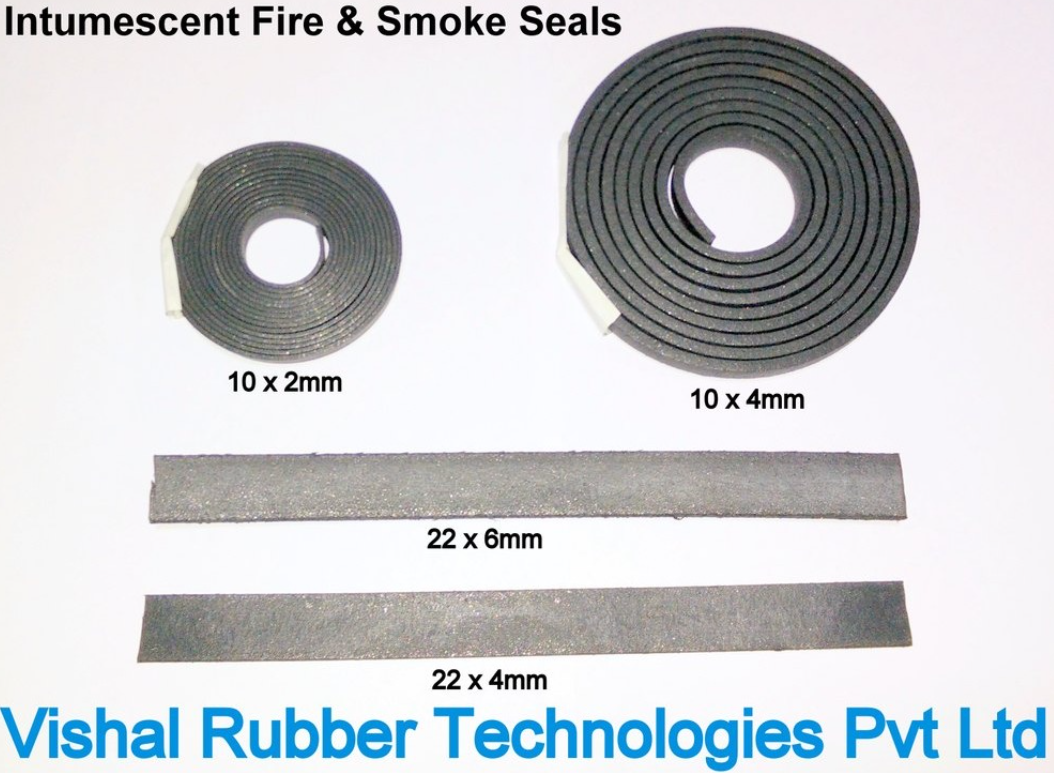
Fire Intumescent Rubber Smoke Seals are designed for this type of passive fire-protection application. When exposed to high heat, intumescent material expands, helping close gaps around the protected opening.
For fire-door manufacturers, contractors, building-product companies in Pune, Maharashtra, correct seal selection begins with the door design itself.
What Happens During Fire Exposure?
Under normal conditions, an intumescent seal occupies relatively little space within the door assembly.
When exposed to fire-related heat, the intumescent material expands substantially. This expansion helps close the designed clearance between the door leaf plus frame.
The purpose is to support the fire-resisting function of the assembly by restricting pathways through which flames, hot gases, smoke could travel.
The component should therefore be considered part of the complete tested door system rather than a decorative accessory.
Seal Dimensions Matter
Fire-door construction can vary considerably.
Wooden doors, steel doors, composite doors, glazed assemblies can use different profiles, rebates, clearances.
Seal dimensions need to suit the intended construction.
A manufacturer may require a narrow strip for one frame design while another assembly may need a wider profile.
Before sourcing, confirm
Seal width
Seal thickness
Groove dimensions
Door construction
Frame construction
Required length
Installation position
Project specification
These details help prevent ordering a profile that cannot be installed correctly.
Placement Is Critical
Even a suitable material can perform poorly when positioned incorrectly.
The seal must be installed according to the approved door design. Groove dimensions, continuity, corners, hardware locations require attention.
Gaps created during installation can compromise the intended function.
Manufacturers should therefore integrate seal placement into their production drawings plus quality checks.
Hardware Areas Need Special Attention
Hinges, locks, glazing details, other hardware can interrupt the sealing path.
Fire-door designers need to consider how the specified passive fire components interact with these areas.
The objective is to maintain the required protective arrangement without interfering with normal door operation.
This makes accurate component geometry particularly important for OEM production.
Custom Profiles May Be Necessary
Not every fire-door assembly uses a standard rectangular strip.
Special glazing applications, frame designs, construction details may require different profile shapes.
Vishal Rubber Technologies Pvt. Ltd. lists intumescent fire smoke seals for wooden, composite, steel fire-door assemblies, with multiple standard dimensions plus custom shapes for applications such as glazing.
For manufacturers in Pune, sharing the actual section drawing can help determine whether an existing profile suits the assembly.
What Buyers Should Check
Purchase teams should avoid sourcing purely by price per metre.
Important questions include
Does the profile match the approved door construction?
Is the required size available?
Is custom production necessary?
What material information is available?
What project documentation is required?
How will the seal be installed?
What quantity is needed per production batch?
These questions move the discussion from commodity purchasing toward application suitability.
Local Supply Considerations
Pune has an active ecosystem of door manufacturers, construction-product suppliers, engineering companies, infrastructure contractors.
Local manufacturing support can be useful when prototypes, unusual dimensions, repeat production requirements need technical coordination.
Production planning should also consider total seal length per door, cutting allowance, expected monthly door output, inventory requirements.
Treat the Seal as Part of the System
Fire Intumescent Rubber Smoke Seals perform a specialised function within passive fire-protection assemblies.
Correct size, placement, profile geometry, installation quality, project compliance all contribute to successful use.
For procurement managers, the strongest RFQ contains more than a required length. Providing the door type, section dimensions, profile drawing, expected volume, relevant project requirements gives the manufacturer enough information to evaluate the component properly.