Electronic equipment can be affected by electromagnetic interference from nearby circuits, power systems, communication devices, industrial machinery. Sensitive equipment may also generate emissions that need to be controlled within the enclosure.
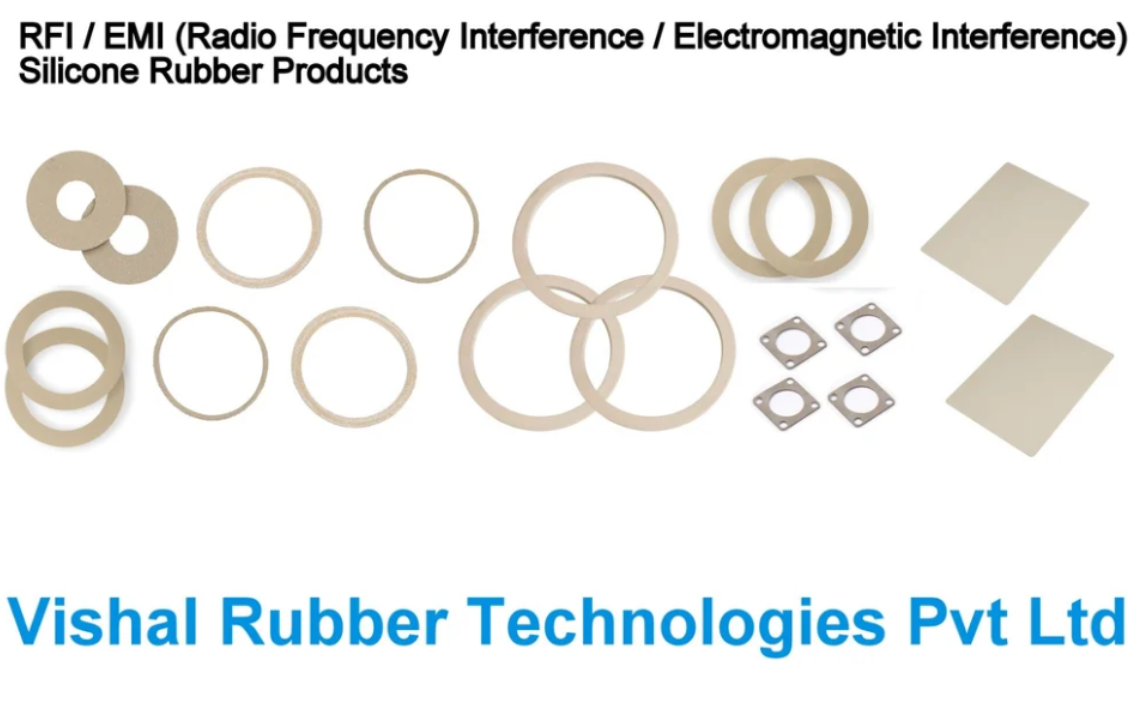
EMI/RFI Silicone Rubber Components can provide sealing plus conductive shielding functions when engineered for the relevant enclosure.
For electronics manufacturers, control-panel builders, instrumentation companies, OEMs in Pune, Maharashtra, component selection should begin with the electrical plus mechanical requirements of the assembly.
Why Conductive Elastomer Components Are Used
A conventional elastomer gasket can close a physical gap, but electromagnetic shielding requires an electrically conductive path across the enclosure interface.
Conductive silicone compounds are formulated to provide elastomeric behaviour while supporting electrical conductivity.
This can make them useful where equipment needs both environmental sealing plus electromagnetic shielding at joints, covers, doors, connector areas.
Start With the Shielding Requirement
Before selecting a profile, engineers should define the interference problem.
Important information can include
Frequency range
Required shielding performance
Enclosure material
Surface finish
Contact area
Compression space
Operating temperature
Environmental exposure
Without these details, selecting a conductive elastomer based only on dimensions can produce an ineffective interface.
Compression Controls Contact
The gasket must make suitable contact with the mating surfaces.
Insufficient compression can create discontinuities. Excessive compression can damage the gasket, increase closure force, reduce long-term performance.
The design should provide controlled compression across the sealing path.
Fastener spacing also matters. Widely spaced fasteners can allow gaps to develop between fixing points.
This is why gasket selection should be considered during enclosure design rather than added after the housing is completed.
Silicone Offers Useful Environmental Characteristics
Silicone materials are widely used in electronic applications because suitable formulations can tolerate broad temperature exposure while maintaining flexibility.
Conductive formulations add shielding capability through conductive fillers.
The specific compound needs to match the electrical requirement plus service environment.
Design teams should evaluate the complete material specification rather than assuming all conductive silicone behaves identically.
Geometry Influences Installation
Conductive components can be produced in profiles, strips, moulded shapes, application-specific configurations.
The geometry should fit the enclosure without creating excessive assembly force.
A well-designed component can support repeatable installation during production.
For OEM programmes, engineers should review
Cross-section
Corner treatment
Joint locations
Compression allowance
Mounting method
Dimensional tolerance
These details become particularly important when hundreds of enclosures are assembled using the same component.
Prototype Before Volume Production
Prototype evaluation is valuable for specialised shielding components.
A sample allows the design team to verify fit, compression, closure force, physical sealing before committing to production quantities.
Where shielding performance is critical, the completed enclosure should be evaluated using the test approach required by the product specification.
This prevents procurement from treating the gasket as an isolated component when actual performance depends on the complete enclosure interface.
Pune Electronics Manufacturing Context
Pune supports industrial automation, automotive electronics, electrical equipment, instrumentation, control systems, engineering manufacturing.
This creates demand for specialised elastomer components that need to meet more than a basic sealing function.
Vishal Rubber Technologies Pvt. Ltd. manufactures industrial rubber components in Pune. Its published material information notes that silicone formulations can be produced across highly conductive through highly insulating ranges for electronic applications.
For buyers, the useful starting point is a detailed component drawing plus the required electrical performance.
Make the RFQ Application Specific
A strong enquiry for EMI/RFI Silicone Rubber Components should identify the enclosure, cross-section, dimensions, compression space, operating conditions, quantity, electrical requirement.
This gives engineering teams a better basis for reviewing samples while giving procurement teams clearer criteria for supplier comparison.
Shielding components work as part of an electrical plus mechanical system. Selecting them with both functions in mind can reduce redesign, assembly difficulties, inconsistent performance later in production.