A silicone roller can resist Pune’s sun, ozone, rain and heat, yet still fail quickly when grit, cutting, oil or repeated compression controls the duty. By comparing the machine’s contact conditions, roller construction, test evidence and total replacement cost, you can decide whether silicone earns its premium or whether EPDM, polyurethane or another cover is the safer choice.
Key takeaways
- Match the roller cover to chemicals, temperature, traction and compression duty.
- Specify bearings, shaft, core, tolerances and cover hardness—not only silicone.
- Measure diameter, face width, shaft and runout before ordering a replacement.
- Pay for silicone when clean release, heat resistance or chemical compatibility prevents downtime.
Where irrigation equipment actually uses rollers—and where silicone earns its keep
Rollers appear in hose-reel drives, squeeze-tube fertigation pumps, self-cleaning filtration systems, tube-handling assemblies, and agricultural film or pipe-processing equipment. Their job may be traction, metering, compression, guiding or clean release; the machine’s duty matters more than the word “irrigation.”
- Hose-reel drives use rollers to grip and wind irrigation hose.
- Fertigation and dosing equipment uses pinch rollers to compress flexible tubes.
- Filtration systems may use rollers to move screens, belts or cleaning elements.
- Tube-handling and pipe-processing assemblies use rollers for guiding, feeding and surface contact.
- Film-processing equipment uses rollers to transport agricultural films or coated sheets.
For silicone rubber rollers for irrigation equipment in Pune, the strongest case is outdoor exposure: ultraviolet sunlight, ozone, rain, monsoon humidity and elevated ambient temperatures. Silicone resists weathering and offers smooth release, but its low tear and abrasion resistance can shorten life at a gritty nip or high-load traction point.
| Operating condition | Why silicone earns consideration | Check before choosing |
|---|---|---|
| Sunlight, ozone and rain | Strong weather resistance | Seal the core, bond and bearings against water |
| Wet product or clean release | Smooth surface can reduce sticking | Test traction on a contaminated wet film |
| High ambient temperature | Retains useful flexibility across a broad temperature range | Confirm the actual temperature and speed |
| Dust, grit or high nip load | Usually a poor abrasion choice | Compare polyurethane or a suitable EPDM compound |
| Oil or solvent contamination | Do not assume silicone compatibility | Test the exact fluid and concentration |
That is the practical meaning of silicone roller benefits in Pune: weathering life can justify the premium, but not when abrasion, slip or contamination controls service life.
Silicone versus EPDM, polyurethane and nitrile: match the cover to the failure mode
Choose the cover by the damage that ends the roller’s life, not by its advertised temperature limit. Silicone roller benefits in Pune include strong resistance to ultraviolet light, ozone, rain and hot outdoor conditions, but silicone can fail quickly where grit cuts the surface or repeated nip loads cause tearing.
| Material | Handles well | Main failure risk | Choose it when |
|---|---|---|---|
| Silicone | Sunlight, ozone, rain, water and clean release | Abrasion, cuts, tearing, hydrocarbon oils and some solvents | Weathering, low contamination or temperature margin dominates |
| EPDM | Water, hot water, weathering and many dilute aqueous chemicals | Petroleum oils, fuels and some solvents; lower mechanical performance than polyurethane | Wet outdoor service, after testing the fertiliser or pesticide mixture |
| Polyurethane | Grit abrasion, cutting, load and traction | Hydrolysis in unsuitable grades, heat limits and some chemicals | A dirty nip, high contact pressure or heavy cycle count controls life |
| Nitrile (Buna-N) | Mineral oils, greases and many oil-contaminated duties | Ozone, sunlight and weathering; weaker choice for persistent outdoor exposure | Oil is the main contaminant and the roller is shielded from direct weather |
Do not treat “fertiliser-resistant” or “pesticide-resistant” as a material label. Concentration, temperature, contact time and wetting agents can change the result; immerse a sample of the proposed cured compound and inspect hardness, swelling, tack and cracking.
Silicone is usually poor value where grit abrasion, high tear loads or oil exposure sets service life. Compare expected cycles, downtime, cleaning, rejected components and replacement labour. Also specify the core, bond and edge sealing: monsoon water can corrode the core or destroy the adhesive while the silicone surface still looks sound.
Specify the roller as an assembly, not just a silicone cylinder
A quotation is complete only when it defines the roller as a rotating assembly: metal core, bonded silicone cover, shaft, bearings, seals and end hardware—not a silicone cylinder priced by diameter. For industrial silicone rollers in Pune, give the supplier machine speed, conveyed material, counterface, nip force, wet or dry duty and target service life.
- State core material, wall thickness, shaft size, core stiffness, corrosion protection, face width, overall length, outside diameter, cover thickness, edge profile, allowable core runout and required concentricity.
- Identify the silicone compound or grade, cure system, Shore A hardness and tolerance, plus tensile strength, elongation, tear strength and compression set. Request ASTM D2240, D412, D624 and D395 test results.
- Specify the bearing arrangement, shaft fit, seals, end faces, dynamic balance grade and permissible nip load. Without these details, vibration, tracking error or edge damage can appear even when the diameter is correct.
- Name the fluid-compatibility test fluid and require ASTM D471 results for fertiliser, pesticide or cleaning-fluid exposure. State the operating temperature range and rotational speed.
- Require the bond system, adhesive preparation, edge sealing, post-cure condition, and water-immersion and thermal-cycling results. Sun-resistant silicone will not protect a corroding core or failed bond.
| Hardness choice | Advantage | Risk |
|---|---|---|
| Softer silicone | Conforms and grips at low nip force | More deformation, rolling resistance and permanent set |
| Harder silicone | Less deformation and better dimensional stability | Slips more readily on irregular wet surfaces |
Ask for a production coupon from the same compound and cure process; a generic silicone sample proves little.
Measure the existing roller and set up the machine without creating new damage
A replacement is not ready for approval until it matches the machine’s geometry and operating load. Record the following before removing the old assembly; photographs alone will miss shaft runout, uneven wear and a displaced bearing.
1. Measure outside diameter at both ends and the centre, then repeat at four clock positions. Record face width, total length, cover thickness, core diameter, journal diameters, keyway dimensions and bearing-seat dimensions. Note taper, grooves, hard spots and the worn contact band.
2. Check runout with a dial indicator while rotating the shaft. Measure shaft runout, roller concentricity and bearing play separately; a new cover will not cure a bent shaft. Check that the core is stiff enough for the span and nip load.
3. Verify parallelism with a straightedge or laser across the roller and counterface. Measure the gap at both ends, confirm the shafts are level, and inspect side guides for contact. Unequal gaps create edge loading and tracking errors.
4. Record the machine speed, counterface material, nip setting and actual contact force. Mark the nip with pressure film, then run dry and wet trials using irrigation water and the real operating speed. Record slip, vibration, temperature rise and product tracking.
5. Before fitting silicone rubber rollers for irrigation equipment in pune, clean fertiliser residue, grit and oil from the frame, shafts and guards. Confirm correct bearing fits, key engagement, rotation direction and guard clearance; reject the roller if installation requires forcing it into alignment.
When is the premium worth paying, and how should you evaluate a Pune supplier?
Pay the silicone premium when one failed roller costs more than the material difference: downtime, cleaning, changeover time, rejected irrigation components and lost production cycles all belong in the calculation.
Silicone is a strong choice for sunlight, ozone, rain and elevated temperature; it is a poor bargain at a gritty nip with high tear, abrasion or oil exposure.
For industrial silicone rollers in Pune, compare suppliers against the same decision criteria:
| Decision | What to compare | Evidence to request |
|---|---|---|
| Total cost | Purchase price, downtime, cleaning, rejected parts and expected cycles | Installed-cost calculation using your actual operating conditions |
| Service life | Water, fertiliser, pesticide, UV, temperature, speed and nip load | Cycles or hours from a representative roller, not a brochure estimate |
| Test evidence | Hardness, tensile, tear, compression set and fluid response | ASTM D2240, D412, D624, D395 and D471 results for the proposed compound |
| Manufacturing capability | Core stiffness, cover thickness, bonding, runout, balance, bearings and permissible nip load | Dimensioned drawing, inspection report and bearing specification |
Ask a silicone rubber roller supplier in Pune for a coupon or production sample made with the same compound and cure process. A generic silicone swatch proves little: filler loading, post-cure, texture and bonding chemistry alter wear, traction and compression set.
Vishal Rubber Technologies Pvt. Ltd. should be judged by whether its quotation and inspection records address those assembly details, rather than by silicone hardness alone. Verify wet traction too; a smooth, low-energy surface can release cleanly while slipping on contaminated water.
Related product
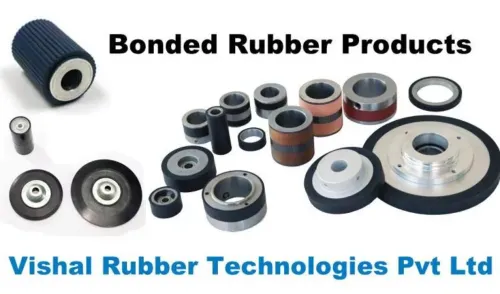
 | Metal Bonded Rubber Silicone rubber has historically been used in specialty applications in order to meet requirements other elastomers cannot. View product → |
Frequently asked questions
Where are rollers used in irrigation equipment?
Rollers appear in hose-reel drives, squeeze-tube fertigation pumps, self-cleaning filtration systems, tube-handling assemblies, and agricultural film or pipe-processing equipment. Their duty may be traction, metering, compression, guiding or clean release.
How does silicone compare with EPDM, polyurethane and nitrile for rollers?
Silicone suits applications needing clean release, broad temperature performance or contact with some fertilizers and water-treatment chemicals. EPDM fits water, steam and weather exposure; polyurethane provides abrasion resistance and high load capacity; nitrile suits oil and grease exposure. Choose from the actual failure mode rather than the material name alone.
What should you specify when ordering a silicone rubber roller?
Specify the complete assembly: core material, finished diameter, face width, cover thickness, hardness, shaft or bore, bearings, end fittings, concentricity, runout, surface finish and operating environment. Include speed, load, compression, chemicals and temperature.
How should you measure and install a replacement roller?
Measure the existing roller's finished diameter, face width, shaft diameter, bore, keyway, bearing seats and runout. Check alignment, nip pressure and parallelism during installation so excessive compression does not damage tubing or create uneven wear.
When is a silicone roller worth the premium?
The premium is justified when silicone's clean release, temperature range or chemical compatibility prevents sticking, contamination, tube damage or frequent replacement. Compare total service life, downtime, cleaning effort and the cost of failed irrigation equipment.