A PTFE sheet for machinery is not made by simply melting plastic and cutting it to size. The resin grade, forming route, sintering cycle, cooling rate and inspection method determine whether the finished sheet stays flat, resists creep and performs reliably in a gasket, liner, guide or wear component.
Key takeaways
- Specify virgin or filled PTFE according to load, wear and chemical exposure.
- Choose moulded sheets for thickness and skived sheets for broad, thin sections.
- Request sintering records, dimensions, density and visual inspection results.
- Define temperature, pressure, movement, tolerances and surface finish in writing.
From PTFE powder to a finished industrial sheet
PTFE resin is chosen for the service conditions before any sheet is formed. The manufacturer selects virgin or filled powder, blends additives uniformly, and checks the powder for contamination and moisture. Because PTFE has extremely high melt viscosity, it is not processed like a conventional injection-moulded thermoplastic.
1. Charge the blended powder into a mould or compacting tool. Apply pressure to cold-compress it into a stable preform.
2. For a moulded sheet, compression-mould the preform to approximate dimensions. For a skived sheet, sinter a cylindrical billet first, then peel a continuous strip from the rotating billet.
3. Sinter the preform or billet through a controlled heating cycle above PTFE’s crystalline melting range. Heat rate, soak time and load control affect density, voids and internal stress.
4. Cool the material in a controlled cycle. Rapid cooling can increase distortion, residual stress and dimensional change.
5. Trim edges and remove surface imperfections. Skived stock is cut from the continuous strip; moulded stock is machined or surface-finished to the specified thickness.
6. Inspect thickness, width, length, flatness, surface condition and visible defects. Measure final dimensions after the sheet returns to the specified inspection temperature because PTFE expands, contracts and elastically recovers during machining.
7. Cut the inspected sheet into gasket blanks, lining panels or machining blanks. This sequence describes the ptfe sheet manufacturing process and how PTFE sheets are made for industrial machinery in Pune.
Moulded and skived sheets are made by different routes
A moulded sheet is compressed into a preform and sintered; a skived sheet is peeled from an already sintered billet. That difference affects thickness, flatness, structure and machining behaviour.
| Route | Formation | Size and structure | Surface finish | Suitable machinery uses |
|---|---|---|---|---|
| Moulded | PTFE powder is cold-compressed in a mould, sintered, cooled and finished | Thick sections and near-net shapes; dimensions follow the mould | Mould surface or subsequent machined finish; edges need trimming | Thick gaskets, valve parts, machined rings and robust sealing components |
| Skived | A rotating cylindrical billet is peeled into a continuous strip, then cut to length | Efficient thin, wide sheet; width and length depend on billet diameter and skiving equipment; peeling can create directional properties and residual curl | Usually smooth and continuous, with possible peeling marks | Linings, electrical insulation, thin gaskets and gasket blanks |
For moulded PTFE sheets in Pune, ask whether the sheet is supplied close to mould dimensions or machined after sintering. Moulding suits a required thickness or shape, but mould size can limit large-format sheets and introduce parting or trimming features.
For skived PTFE sheets in Pune, check flatness after the sheet has relaxed. Residual curl can complicate bolted gasket assembly, while directional behaviour can affect creep, permeability and machining accuracy.
Neither route is automatically better. State the route, thickness tolerance and required surface finish on the drawing; measure machined parts after they return to the specified inspection temperature because PTFE expands, contracts and elastically recovers.
The sintering cycle and inspection determine usable quality
A sintering chart is the first evidence of usable quality. PTFE passes its crystalline melting transition at approximately 327 °C, but a reliable cycle uses a controlled heating profile, soak and cooling rate rather than one setpoint.
Heat too quickly and trapped air or voids can remain; cool too quickly and residual stress can produce warpage or later dimensional movement.
Check the batch before releasing it for machining:
- Measure thickness, length, width and flatness at the specified inspection temperature, after the sheet has reached thermal equilibrium.
- Calculate density from recorded mass and measured volume; a low or uneven result can indicate porosity or incomplete consolidation.
- Inspect both faces and edges for cracks, blisters, pits, laminations, colour changes and machining damage from trimming.
- Compare several points across the sheet, not only one corner. Variation exposes uneven compression, non-uniform cooling or local voids.
- Confirm the sintering record identifies the resin or compound lot, preform dimensions, peak temperature, hold time and cooling profile.
| Route | Main quality risk | Check before machining |
|---|---|---|
| Moulded | Warpage from uneven compression or cooling | Map flatness and thickness across the sheet; inspect edges for density differences |
| Skived | Thickness variation, curl or residual stress from peeling the billet | Measure thickness across the strip, check curl after conditioning and verify cut edges |
Machine only after these results meet the drawing tolerances. Allow for PTFE’s elastic recovery and thermal expansion, then remeasure the finished part at the same inspection temperature; cutting hot or using dull tools can smear surfaces and distort thin sections.
Choose the grade for load, movement and service conditions
Choose virgin PTFE for low-friction, chemically demanding service when the sheet carries modest sustained load. Choose a filled grade when wear, compressive deformation, or dimensional stability matters more than maximum chemical purity.
PTFE sheet applications include gaskets, valve seats, sliding pads, wear strips and linings, but an unsupported sheet is a poor structural bearing where stiffness or high-energy abrasion resistance is critical.
| Grade | Advantages | Risks and selection checks |
|---|---|---|
| Virgin PTFE | Lowest friction, broad chemical resistance, electrical insulation | Cold flow and creep under sustained compression; needs adequate flange support and controlled bolt load |
| Glass-fibre-filled PTFE | Higher compressive strength and wear resistance | Reduced chemical purity; fibres can be attacked by some chemicals and increase abrasiveness |
| Carbon- or graphite-filled PTFE | Better wear performance, stiffness and heat transfer | Changes electrical properties and friction; confirm chemical compatibility |
| Bronze-filled PTFE | Improved load capacity and dimensional stability | Metal filler can corrode or contaminate aggressive service; avoid where chemical purity matters |
Cold flow is immediate deformation under load; creep is continuing deformation over time. Both can reduce gasket contact pressure or alter a sliding clearance. Check load, duration, geometry and operating temperature together, not PTFE’s melting point alone. Continuous high-temperature service accelerates stress relaxation and can oxidise certain fillers.
Ask for the exact compound designation and filler percentage. A specification that says only “PTFE sheet” cannot reveal whether the filler will survive the chemical exposure or increase friction beyond the machinery’s limit.
Write a purchase specification that defines performance
A drawing that says “PTFE sheet” does not define a performance grade. State the service conditions and acceptance evidence in the purchase order before requesting quotations.
1. Specify the compound: virgin PTFE or the exact filled grade, including filler type and percentage. Do not accept “filled PTFE” without this information.
2. Name the manufacturing route: compression-moulded or skived. Specify nominal and minimum thickness, length, width, flatness, and permitted thickness and dimensional tolerances.
3. State operating temperature, compressive load or pressure, movement, service duration, and chemical exposure. A temperature rating without load and time is incomplete.
4. Define required density and mechanical properties, such as tensile strength, elongation, hardness, or compressive creep, using the test method and acceptance limits. Ask for the compound batch number and certificate of analysis.
5. Specify surface requirements: roughness limit, scratches, pinholes, edge condition, colour, and allowable warpage. State that machined dimensions must be checked after the part returns to 23 ± 2 °C.
6. Name the inspection evidence: dimensional report, density result, visual inspection record, and the standard used for each test. Request a sample or first-article report when flatness or machining behaviour controls fit.
7. Identify compliance requirements precisely, such as ASME B16.21 for a gasket application or FDA 21 CFR 177.1550 for food contact, when applicable.
Vishal Rubber Technologies Pvt. Ltd. can be compared with other suppliers on this documented compound, route, and inspection package—not on the words “PTFE sheet” alone.
Related product
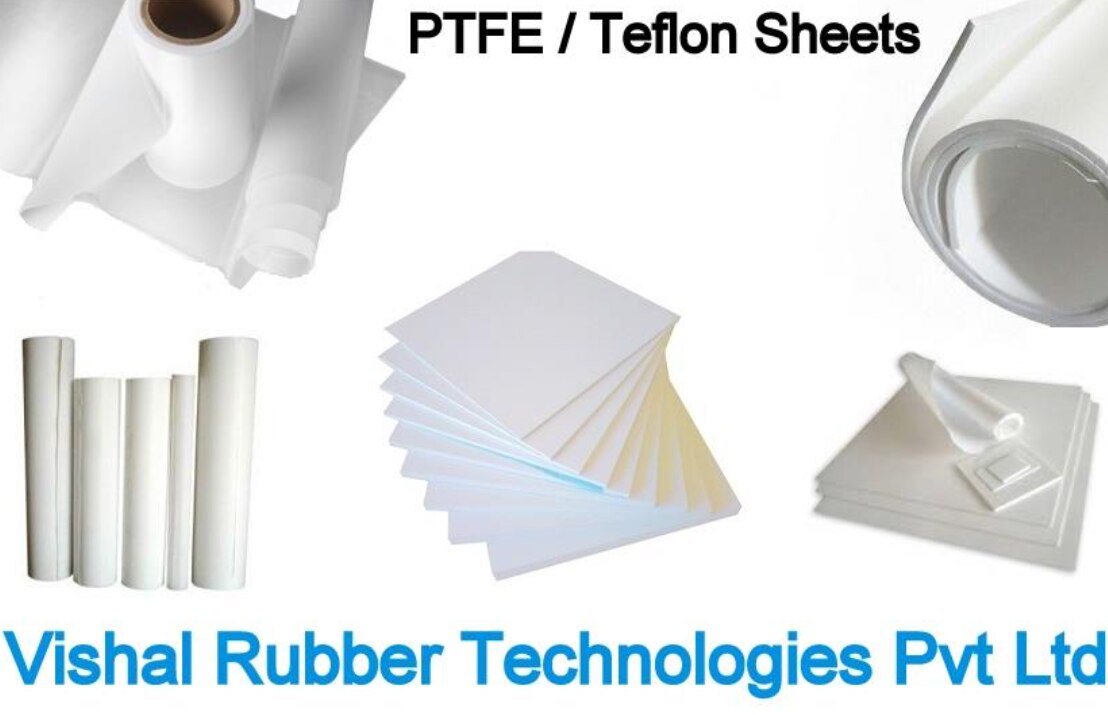
 | Teflon / PTFE PTFE Sheets are typically of two types, namely Skewed PTFE Sheets and Moulded PTFE Sheets. View product → |