The correct packing depends on equipment geometry and operating duty, not on the word “PTFE” or the equipment’s nominal size. By recording the dimensions, service conditions and movement type, you can separate a suitable gland packing from a flange gasket or static seal and compare options that will survive the job.
Key takeaways
- Measure shaft diameter, box bore and depth before ordering packing rings.
- Select PTFE construction by temperature, shaft speed, chemicals and abrasive service.
- Set gland adjustment and flush requirements for pumps, mixers and valve stems.
- Give suppliers dimensions, equipment duty and operating conditions for accurate quotations.
Start with the equipment duty, not the product name
A pump shaft, mixer shaft, agitator shaft or valve stem determines the gland duty. A packing gland is a compression sealing system fitted around a moving member; it is not a flange gasket sealing two stationary faces, a static seal or diaphragm, a machined PTFE component, or a PTFE cable gland for electrical cable entry.
| Service type | Equipment example | Selection priority |
|---|---|---|
| Rotary | Pumps, agitators, mixers | Shaft speed, friction, heat dissipation, sleeve condition and controlled flush |
| Reciprocating | Moving valve stems and rods | Movement frequency, stem finish, straightness, pressure cycling and compression |
| Static | Flange, cover or stationary joint | Use a flange gasket or static seal, not rotary shaft packing |
For pumps, agitators and mixers, excessive compression can create frictional heat, score the sleeve and overload the motor. Check the shaft speed, sleeve condition, flush path and available heat removal before selecting PTFE packing.
For valves, stem movement, cycling, pressure changes, stem finish, straightness, stuffing-box geometry, operating torque and fugitive-emission requirements matter more than pump-style speed calculations. The same PTFE packing can suit a valve and fail on a high-speed pump shaft.
The phrase ptfe gland for industrial maintenance is a specification category, not a universal product. Define the equipment duty, movement type, dimensions and leakage requirement before choosing a construction; compression packing provides controlled leakage, not a promise of zero leakage.
Measure the stuffing box before ordering packing rings
Measure the shaft or sleeve outside diameter and the stuffing-box bore diameter with suitable callipers or micrometres. Calculate radial space as (bore diameter minus shaft diameter) divided by two. Do not select packing by shaft diameter alone.
1. Match the calculated radial space to the nearest standard square packing size, then confirm that size with the equipment maker or supplier. An incorrect cross-section can prevent compression, extrude into clearance, or consume all available follower adjustment.
2. Record the stuffing-box depth, existing ring count, gland-follower travel and remaining adjustment. These figures show whether the ordered rings will fill the box without leaving the follower fully tightened or unable to compress the set.
3. Check whether a lantern ring is specified. Record the flush or lubrication port’s axial position and verify that the lantern ring will align with it; a misplaced ring can block the flush path, while a missing flush can let abrasive solids destroy otherwise suitable PTFE packing.
4. Inspect the shaft or sleeve for scoring, eccentricity, corrosion, excessive clearance, rough finish and inadequate hardness. These defects generate heat, accelerate wear and can defeat PTFE packing for equipment shafts even when the chemistry is compatible.
5. Confirm whether rings require the specified angle cut or butt joints. Install one ring at a time and stagger adjacent joints rather than aligning them, which creates a direct leakage path. Record these measurements and installation details before sourcing.
Compare PTFE constructions against heat, wear and chemical exposure
Choose the packing construction by duty, not by the label “Teflon.” These packing gland options for maintenance teams differ in friction, strength, heat handling and chemical exposure.
| Option | Main advantage | Compare it for |
|---|---|---|
| Pure or virgin PTFE | Broad chemical compatibility and low friction | Clean, corrosive or solvent service with moderate speed and controlled compression |
| Lubricated PTFE | Lower running friction | Rotary service when the lubricant is compatible with the medium and cleaning chemicals |
| Graphite-impregnated PTFE | Better heat transfer and rotary-wear behaviour | Pumps, mixers and agitators where frictional heat matters |
| PTFE-aramid blend | Greater mechanical strength and resistance to extrusion or abrasion | Higher pressure, clearances, abrasive solids or demanding shaft service |
| Carbon or graphite packing | Strong heat handling and rotary-wear performance | Service where temperature and rotary wear dominate chemical compatibility |
Pure PTFE is a poor choice when sustained compression causes creep or cold flow, clearances invite extrusion, or high speed, abrasive solids, rough sleeves or poor heat dissipation generate damaging friction. Check temperature, pressure, shaft speed, medium, pH, solids concentration and cleaning chemicals.
The commonly quoted 260 °C limit applies to PTFE resin, not automatically to a complete braid; filler, lubricant, gland load, speed and equipment limits can lower it. Verify compatibility with molten alkali metals, elemental fluorine and high-temperature fluorinating environments. These checks make sense of teflon packing gland applications without promising leak-free service.
Match pump, mixer and valve installation practices to the sealing duty
On pumps, agitators and mixers, packing performance depends on controlled compression and heat removal, not simply on stopping visible leakage. Tighten the follower gradually and evenly; excessive compression can score the shaft, increase motor load, create thermal damage and cause early failure.
During run-in, control leakage to the equipment design instead of forcing a dry stuffing box when leakage is needed for cooling.
Use a lantern ring only when the flush or lubrication port is correctly positioned and the ring aligns with it. A misplaced ring can block the flush path, while omitted flush can let abrasive solids destroy suitable PTFE packing.
For valve installation, apply these controls:
- Select packing that tolerates stem movement and pressure cycling, then verify the valve manufacturer’s pressure, fugitive-emission and operating-torque requirements.
- Cut rings to the specified angle or butt-joint arrangement, install them one at a time, and stagger joints so adjacent gaps do not align.
- Check stem finish, straightness, stuffing-box geometry and available follower adjustment; nominal valve size alone is not a specification.
Reconsider packing gland options for maintenance teams when abrasive slurry, severe contamination, excessive speed, inadequate flush, damaged sleeves or stringent zero-emission limits make conventional PTFE unsuitable. Reinforced packing, sacrificial end rings, a mechanical seal or a bellows-sealed valve may fit the duty better. Compression packing is controlled-leakage technology, not a promise of leak-free operation.
Build a Pune maintenance specification suppliers can quote accurately
Send a complete quote request for ptfe packing glands for maintenance applications in Pune: state the equipment type, manufacturer, and whether movement is rotary, reciprocating, or static. State allowable leakage or emissions and whether service is clean, corrosive, abrasive, high-temperature, or food-related.
- Give shaft or stem diameter, sleeve diameter, stuffing-box bore and depth, existing ring count, lantern-ring location, follower adjustment, medium, pH, pressure, temperature, solids concentration, cleaning chemicals, and rotary speed where applicable.
- Ask for packing cross-section, braid construction, virgin or expanded PTFE designation, lubricant or filler, reinforcement, temperature and pressure limits, shaft-speed limit, surface-finish and hardness requirements, compatibility data, and installation instructions.
| Construction | Specify | Why it matters |
|---|---|---|
| Virgin PTFE | Unfilled, non-expanded designation | Chemical resistance, but creep and extrusion risk under sustained compression |
| Expanded or lubricated PTFE | Expansion method and lubricant chemistry | Low friction and valve torque, subject to lubricant compatibility |
| Filled or reinforced PTFE | Filler type, braid, reinforcement, and limits | Greater dimensional stability or abrasion resistance |
| PTFE/graphite | Graphite content, temperature, pressure, and speed limits | Improved heat transfer and rotary-wear behaviour |
“PTFE” alone does not identify whether the product is lubricated, filled, expanded, or reinforced. Vishal Rubber Technologies Pvt. Ltd. can be one supplier for this comparison, provided its quotation includes a complete datasheet and is checked against the equipment maker’s limits, not the label “Teflon gland.”
Choose the construction that meets measured geometry and documented duty, then confirm installation and run-in controls before purchase.
Related product
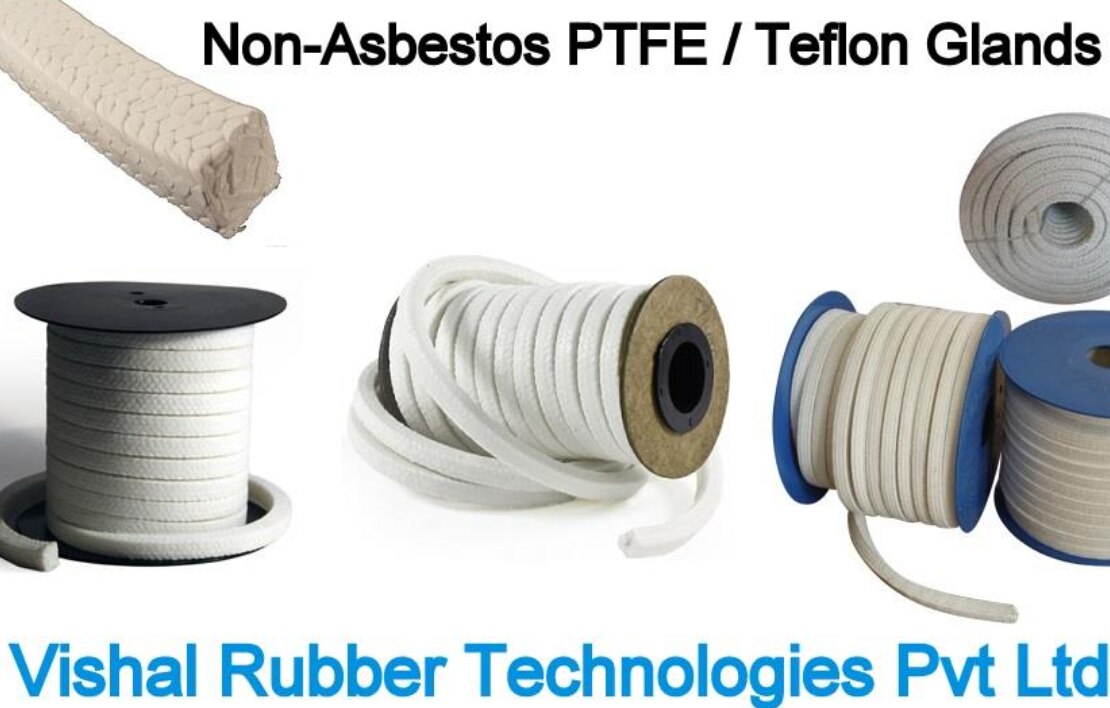
Teflon / PTFE ₹1350 Pure Teflon packing rope is flexible, chemically inert, dimentionally stable with low coefficient of friction and excellent compression resistance... View product → |
Frequently asked questions
What should you measure before ordering PTFE packing for equipment shafts?
Measure the shaft or stem diameter, stuffing-box bore, available depth and existing ring dimensions. Record the number of rings and inspect the shaft, sleeve and box for scoring.
How do you compare PTFE packing constructions for maintenance applications?
Compare virgin PTFE, expanded PTFE and lubricated or reinforced constructions against temperature, shaft speed, chemical exposure, abrasion and required compression. Do not choose by material name alone.
Which equipment uses PTFE packing glands?
PTFE packing glands suit selected pump shafts, mixer and agitator shafts, and valve stems when the stuffing-box dimensions, movement and process conditions match the packing construction.
What information should a Pune maintenance specification include?
State the equipment type, shaft or stem size, stuffing-box dimensions, medium, temperature, pressure, speed, pH or chemicals, leakage limit, flush arrangement, packing size and required documentation.