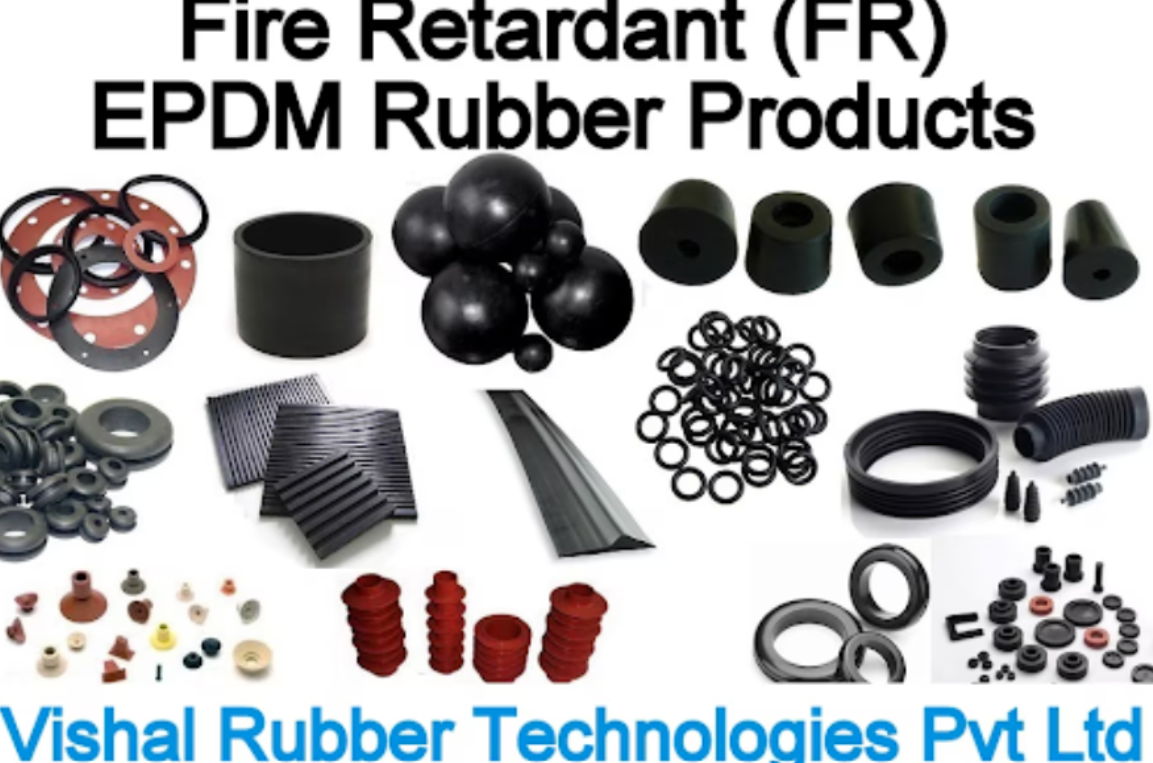
Fire Retardant Rubber Products are developed for applications where ordinary elastomer performance may not satisfy the fire behaviour expected from the finished equipment.
This requirement can appear in railway equipment, electrical enclosures, industrial machinery, public infrastructure, transportation systems, specialised OEM assemblies.
For engineering teams in Pune, Maharashtra, understanding what fire-retardant performance actually means is important before selecting a rubber component.
Fire Retardancy Is an Application Requirement
Rubber components can perform several functions inside equipment. They may provide sealing, cushioning, insulation, vibration control, protection, spacing.
When these components are installed near electrical systems, enclosed equipment, passenger areas, heat sources, fire behaviour may become part of the technical specification.
Fire-retardant material is formulated to achieve defined behaviour when exposed to specified test conditions. This does not mean every such material has identical performance.
The required grade should come from the equipment specification, applicable standard, customer requirement.
Begin With the Relevant Standard
A common purchasing mistake is requesting a generic flame-resistant component without identifying the required test criterion.
Procurement teams should first determine
Applicable fire standard
Required classification
Component thickness
Application environment
Test orientation
End-use sector
Customer documentation requirement
These points matter because fire testing is conducted under defined conditions. A broad claim such as flame resistant provides less procurement value than a clearly specified classification.
Thickness Can Affect the Requirement
Material behaviour during testing may depend on specimen thickness. This makes thickness an important part of the technical discussion.
A buyer should avoid assuming that a test result obtained for one configuration automatically applies to every component geometry.
Where compliance is project-critical, the purchasing specification should identify the exact requirement expected for the intended component.
Consider Normal Service Performance Too
Fire behaviour is only one part of material selection.
The component still needs to perform its primary function during routine operation. Depending on the application, this could involve sealing against dust, resisting weather exposure, absorbing vibration, tolerating temperature changes, maintaining dimensional stability.
Engineers therefore need to evaluate both the fire requirement plus normal operating conditions.
A material with suitable flame characteristics still needs appropriate mechanical properties for its intended use.
Common Industrial Applications
Fire-retardant elastomer components can be considered for
Electrical equipment
Railway assemblies
Metro systems
Control panels
Industrial machinery
Cable-related applications
Equipment enclosures
Transport interiors
Specialised OEM products
The exact material specification should always reflect the final application.
Why Procurement Needs Technical Clarity
Purchase teams often receive a drawing with dimensions but limited material information. This can create uncertainty when multiple compounds appear physically similar.
A stronger enquiry should state the required fire classification plus any other critical properties.
It is useful to include
Drawing
Dimensions
Thickness
Quantity
Fire requirement
Temperature exposure
Environmental conditions
Required test documentation
This information gives a manufacturer a much clearer basis for reviewing the requirement.
Pune Manufacturing Context
Pune's industrial ecosystem includes automotive manufacturing, railway suppliers, electrical equipment producers, engineering companies, machine builders, component manufacturers. Many such businesses manage vendor qualification through technical drawings plus defined material specifications.
Vishal Rubber Technologies Pvt. Ltd. manufactures industrial rubber components in Pune with capabilities covering specialised fire-related rubber requirements. The company states that its manufacturing setup supports custom rubber production plus physical, chemical quality checks.
For procurement teams, the key point is to treat flame performance as a measurable engineering requirement rather than a generic product feature.
Specify Before You Source
A technically useful purchase request should identify the fire standard first, followed by the component geometry, operating environment, quantity, documentation expectations.
This improves communication between design, procurement, supplier quality, manufacturing teams.
Fire Retardant Rubber Products can support demanding industrial applications when the specification reflects both safety-related criteria plus everyday functional requirements. Clear technical inputs at the sourcing stage can prevent unsuitable material selection from becoming an expensive problem later in production.