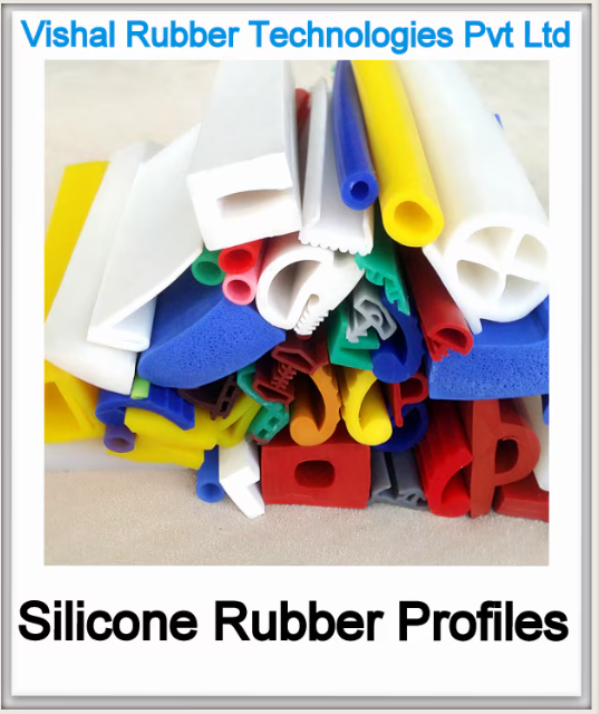
Silicone rubber door profiles provide a flexible sealing barrier around industrial doors, cabinets, ovens, electrical enclosures and specialised equipment. Their primary purpose is to close the gap between mating surfaces and help limit the movement of dust, moisture, heat, air and contaminants.
In Pune’s diverse manufacturing environment, door-sealing requirements can range from ordinary enclosure protection to sustained performance at elevated temperatures. Silicone is frequently considered where general-purpose rubber may harden, crack or lose flexibility under demanding thermal conditions.
What Makes Silicone Suitable for Door Sealing
Silicone rubber is known for retaining elasticity across a broad temperature range. It also provides useful resistance to ozone, ultraviolet exposure and weather-related ageing. These properties make it suitable for equipment that experiences heat, repeated door movement or outdoor exposure.
Depending on the compound and profile design, silicone door seals can offer:
- Consistent flexibility during repeated opening and closing
- Resistance to permanent compression
- Performance under elevated and low temperatures
- Protection against dust and environmental exposure
- Electrical insulation properties
- Availability in different colours and hardness levels
- Compatibility with complex extruded shapes
These are general material characteristics. Actual performance depends on the silicone grade, operating environment and finished profile geometry.
Common Profile Designs
Silicone rubber door profiles are not limited to one standard shape. The design is selected according to the door gap, compression requirement and mounting arrangement.
Solid Profiles
Solid silicone sections provide firmness and dimensional stability. They are often used when the seal must resist deformation or support a defined closing pressure.
Sponge Profiles
Sponge silicone profiles compress more easily and can accommodate variations in door alignment. They are useful where low closing force and greater conformability are required.
Bulb Seals
Bulb-shaped profiles create a compressible sealing zone. They are commonly fitted to cabinet doors, industrial ovens and access panels.
P Profiles and D Profiles
These profiles combine a mounting section with a rounded compression area. They are used where the seal must be positioned accurately along a frame.
Custom Extruded Profiles
Custom extrusion is appropriate when standard sections do not match the equipment design. A dimensional drawing can be used to develop a profile that fits the available groove, edge or fastening method.
Applications in Maharashtra’s Industrial Sector
Manufacturers in Pune and the wider Maharashtra region use silicone rubber door profiles in equipment such as:
- Industrial ovens and heating chambers
- Electrical control panels
- Food-processing machinery
- Pharmaceutical equipment
- Laboratory cabinets
- HVAC enclosures
- Packaging machines
- Railway and transportation systems
- Outdoor electrical cabinets
- Fabricated metal enclosures
Each application creates a different sealing challenge. An oven door profile must tolerate temperature and repeated thermal cycling. An outdoor cabinet seal may need stronger resistance to sunlight, rain and ozone. A food-processing application may also require a compound aligned with relevant hygiene and material compliance requirements.
Choosing the Right Profile
The first step is to measure the gap between the door and frame. A profile that is too large may make the door difficult to close, while an undersized profile may not create sufficient compression.
Other selection factors include:
- Continuous and peak operating temperature
- Required compression percentage
- Contact with oils, chemicals, steam or cleaning agents
- Indoor or outdoor installation
- Solid, sponge or dual-density construction
- Mounting method
- Colour and surface finish
- Regulatory or testing requirements
Compression set is another important consideration. It describes the material’s ability to recover after prolonged compression. A profile with poor recovery may remain flattened and gradually lose sealing contact.
Vishal Rubber Technologies supports the development and production of silicone rubber door profiles for industrial buyers, fabricators and equipment manufacturers in Pune. Providing a drawing, physical sample or clear dimensional details allows the profile to be assessed against the intended installation.
A door seal should also be treated as a functional engineering component rather than a decorative rubber strip. Correct material selection, controlled profile dimensions and suitable compression can contribute to cleaner enclosures, stable equipment conditions and longer service intervals.