Thank you for writing to us. One of our executive will reach back to you through your submitted medium. In case there’s an urgency, feel free to connect over WhatsApp for faster response.
Prefer calling? Dial +918048036916 (International callers) or 8048036916 (Indian callers).
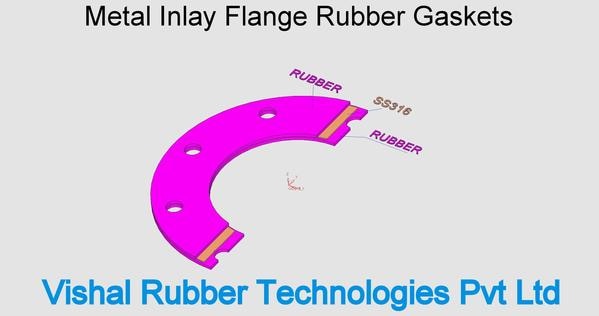
Metal Inlay Flange Rubber Gaskets
Engineered for Reliability. Certified for Global Standards.
Our metal inlay flange rubber gaskets combine the resilience of high-grade elastomers with the structural integrity of precision-engineered steel inserts—delivering unmatched sealing performance across demanding industrial environments.
Key Features:
• Vulcanized Metal Core: Centrally embedded steel (SS304, SS316 etc) ensures blow-out safety and dimensional stability under extreme pressure and temperature.
• Elastomer Versatility: Available in EPDM, NBR, HNBR, FKM, and more—each tailored to resist steam, chemicals, hydrocarbons, and aggressive media.
• Low Surface Pressure Sealing: Achieves tight seals even at reduced bolt torque, minimizing flange stress and installation complexity.
• Wide Temperature Range: Operational reliability up to 200°C, ideal for pipelines, HVAC, chemical processing, and transit systems.
• EPDM variants available with EN45545 HL3 fire safety rating for rail applications.
Applications:
• Rail & Transit (EN45545 HL3-compliant)
• Oil & Gas, Petrochemical
• Power Plants & Industrial Equipment
• Drinking Water & Food-Grade Systems (material-specific)
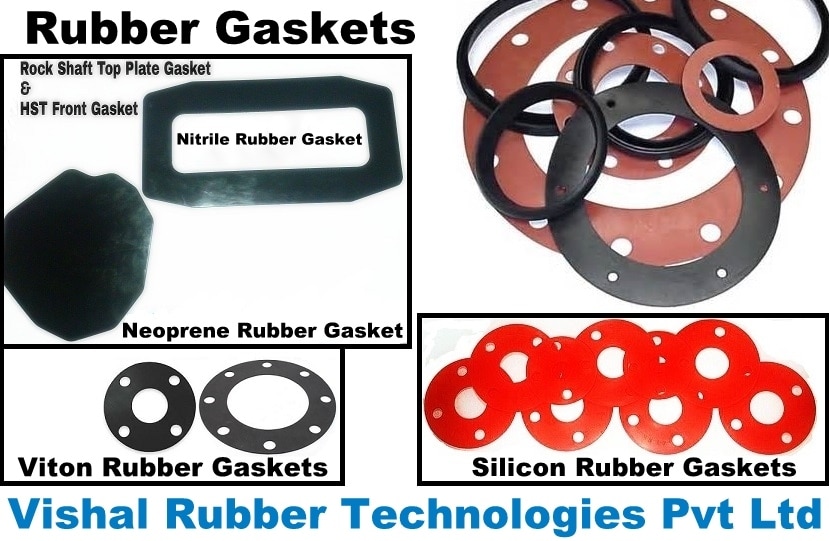
Rubber Gaskets are usually manufactured using Rubber Moulding Process as moulding process is considered for tight bonding of moulecules of rubber rather than cut gaskets. We recommend moulded rubber gaskets for its quality purpose.
There are different types of rubber gaskets used according to purpose and type. Some of the gaskets are Flange and Ring Type Gaskets followed by standards such as ANSI, BS10TD, T-5, T-17, T-11, IS-1538, IS-6392, Body Gaskets, etc.
Rubber gaskets are manufactured according to customer requirement and specifications.
Types of Rubber Gaskets:
1. Natural Rubber Gaskets
2. EPDM Rubber Gaskets
3. Neoprene Rubber Gaskets
4. Nitrile Rubber Gaskets
5. Silicon Rubber Gaskets
6. Viton Rubber Gaskets
7. Butyl Rubber Gaskets
8. Commercial Grade Rubber Gaskets
9. Industrial Grade Rubber Gaskets
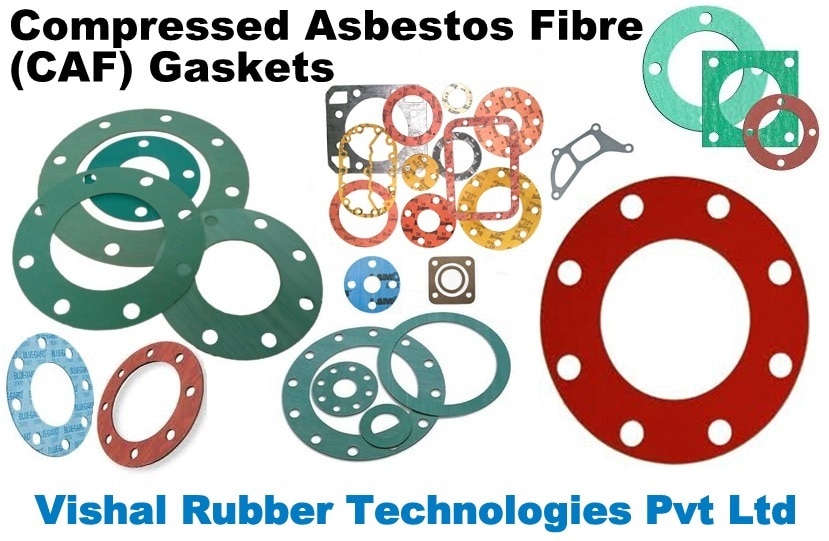
CAF Gaskets
A gasket material that is comprised of asbestos fibers encapsulated within a rubber binder.
This type of gasket is tough, durable and dimensionally stable, relatively incompressible and exhibits low creep characteristics. It also has the ability to effectively form a seal over a wide range of service conditions which has given it a good reputation. Compressed asbestos fiber(CAF) gaskets have good chemical resistance capabilities and a good working temperature range of cryogenic to 1,100F. It is less suitable for low bolt loads such as use with non-metallic flanges and low grade bolts, and is not suitable for use in stainless steel flanges due to its chlorine content which will damage the flanges. However, CAF gaskets can be installed relatively easily due to their ability to handle mechanical abuse, incorrect fitting and bolt-load retorquing
We manufacture and Supply UL 94 EPDM & Silicone Rubber Parts Like FR Strips, FR Grommets, FR Gaskets, FR Orings, FR Sleeves, FR Washers and other moulded or extruded Rubber products.
From Lowest (Least Flame - Retardant) to Highest (Most Flame - Retardant).
Standards are given below for details about its details of testing,
UL 94-5VA
UL 94-5VB
UL 94 V-0
UL 94 V-1
UL 94 V-2
UL 94 H-B
HB: slow burning on a horizontal specimen; burning rate < 76 mm/min for thickness < 3 mm or burning stops before 100 mm
V-2: burning stops within 30 seconds on a vertical specimen; drips of flaming particles are allowed.
V-1: burning stops within 30 seconds on a vertical specimen; drips of particles allowed as long as they are not inflamed.
V-0: burning stops within 10 seconds on a vertical specimen; drips of particles allowed as long as they are not inflamed.
5VB: burning stops within 60 seconds on a vertical specimen; no drips allowed; plaque specimens may develop a hole.
5VA: burning stops within 60 seconds on a vertical specimen; no drips allowed; plaque specimens may not develop a hole.
We manufacture and Supply UL 94 EPDM Rubber Belts, Rubber Gaskets, Rubber Sheets and Rubber Strips as per customer requirements
From Lowest (Least Flame - Retardant) to Highest (Most Flame - Retardant).
Standards are given below for details about its details of testing,
UL 94-5VA
UL 94-5VB
UL 94 V-0
UL 94 V-1
UL 94 V-2
UL 94 H-B
HB: slow burning on a horizontal specimen; burning rate < 76 mm/min for thickness < 3 mm or burning stops before 100 mm
V-2: burning stops within 30 seconds on a vertical specimen; drips of flaming particles are allowed.
V-1: burning stops within 30 seconds on a vertical specimen; drips of particles allowed as long as they are not inflamed.
V-0: burning stops within 10 seconds on a vertical specimen; drips of particles allowed as long as they are not inflamed.
5VB: burning stops within 60 seconds on a vertical specimen; no drips allowed; plaque specimens may develop a hole.
5VA: burning stops within 60 seconds on a vertical specimen; no drips allowed; plaque specimens may not develop a hole.
PTFE Sheets are typically of two types, namely Skewed PTFE Sheets and Moulded PTFE Sheets. Widely used in applications where high abrasion resistance is required, chemical resistance, high heat resistance, Oil & Acid resitance, etc.
PTFE is principally used as a gasket material because of it's capability to remain unaffected by the majority of chemicals used in industry. It is also classified, in most cases, as a food grade material, making it acceptable to both medical and food production industries. There are three basic types of PTFE gasket materials. Virgin PTFE , filled PTFE and expanded PTFE .
Virgin PTFE is by far the least expensive of the three varieties, and is used in most general applications. Filled PTFE is a gasket material with a virgin PTFE base to which a substance is added during manufacture to improve the sealing characteristics of PTFE . This “filler“ usually is glass or graphite particles although ceramics has sometimes been used. The resulting gasket material is strong, yet highly compressible with very good, though not universal, chemical resistance.
Expanded PTFE is virgin PTFE to which a stress resistance has been added by means of molecular rearrangement during manufacture. This process ensures that the molecular chains from which the PTFE is constructed, do not arrange themselves into set patterns. This means that expanded PTFE possesses no structural weakness (grain) and expands and contracts equally in all directions. Because no additives are required, expanded PTFE also possesses the unique chemical resistance of virgin PTFE .
PTFE is principally used as a gasket material because of it's capability to remain unaffected by the majority of chemicals used in industry. It is also classified, in most cases, as a food grade material, making it acceptable to both medical and food production industries. There are three basic types of PTFE gasket materials-Virgin PTFE, Filled PTFE and expanded PTFE.
Virgin PTFE is by far the least expensive of the three varieties, and is used in most general applications. Filled PTFE is a gasket material with a virgin PTFE base to which a substance is added during manufacture to improve the sealing characteristics of PTFE. This “filler“ usually is glass or graphite particles although ceramics has sometimes been used. The resulting gasket material is strong, yet highly compressible with very good, though not universal, chemical resistance.
Expanded PTFE is virgin PTFE to which a stress resistance has been added by means of molecular rearrangement during manufacture. This process ensures that the molecular chains from which the PTFE is constructed, do not arrange themselves into set patterns. This means that expanded PTFE possesses no structural weakness (grain) and expands and contracts equally in all directions. Because no additives are required, expanded PTFE also possesses the unique chemical resistance of virgin PTFE.
We manufacture and Supply UL 94 EPDM & Silicone Rubber Parts Like FR Grommets, FR Gaskets, FR Orings, FR Sleeves, FR Washers and other moulded or extruded Rubber products.
From Lowest (Least Flame - Retardant) to Highest (Most Flame - Retardant).
Standards are given below for details about its details of testing,
UL 94-5VA
UL 94-5VB
UL 94 V-0
UL 94 V-1
UL 94 V-2
UL 94 H-B
HB: slow burning on a horizontal specimen; burning rate < 76 mm/min for thickness < 3 mm or burning stops before 100 mm
V-2: burning stops within 30 seconds on a vertical specimen; drips of flaming particles are allowed.
V-1: burning stops within 30 seconds on a vertical specimen; drips of particles allowed as long as they are not inflamed.
V-0: burning stops within 10 seconds on a vertical specimen; drips of particles allowed as long as they are not inflamed.
5VB: burning stops within 60 seconds on a vertical specimen; no drips allowed; plaque specimens may develop a hole.
5VA: burning stops within 60 seconds on a vertical specimen; no drips allowed; plaque specimens may not develop a hole.
EPDM Rubber Gaskets for Solar Water Heater Panels used for 1 inch pipelines as per BIS no. IS12933(Part II) for thermal shock test.
Type of Gaskets:
1. Blind Rubber Gasket
2. Flange Rubber Gasket
3. Tapered Flange Rubber Gasket
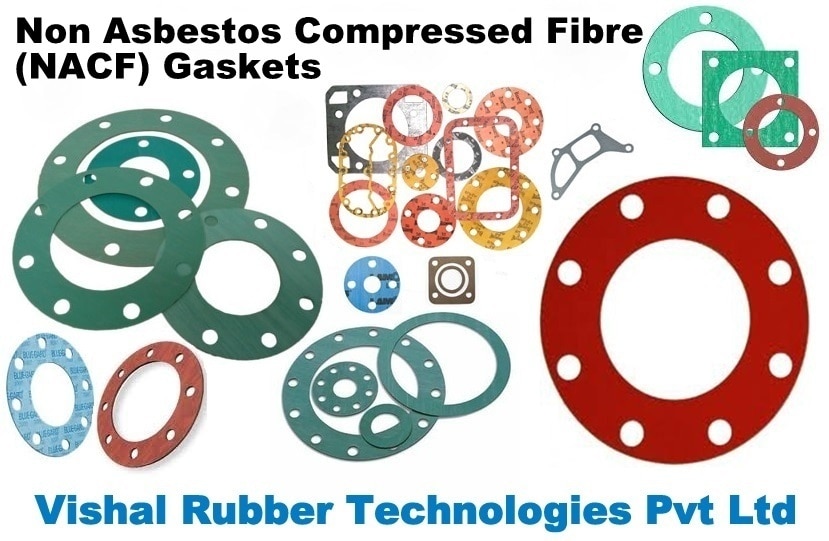
We are one of the largest manufacturers of Gaskets in India. All types of Standard and Non-Standard Gaskets are manufactured. We manufacture Flange & Ring Types of gaskets for all kinds of Water Treatment Plants and Chemical Treatment Plants with Standards like ASME/ANSI (Class 150, Class 300, Class 600, etc), BS10 TD, T-5, T-17, T11, IS 1538, IS 6392, Body Gaskets in all kinds of Brands like Champion Jointing Sheets, Garlock Sheets, Uniklinger, Champion Spitmann, etc.
1) Garlock Blue Gard Style 3000:
Unique blend of aramid fibers, fillers and an NBR rubber binder
Blue color
Min. Temperature: -100°F / -73°C
Max. Temperature: 700°F / 371°C
Continuous Max: 400°F / 205°C
Max Pressure: 1000 PSI / 70 bar
Maximum PxT 1/16: 350,000°F x PSIG / 12,000 bar x °C
Maximum PxT 1/8: 250,000°F x PSIG / 8,600 bar x °C
2) Garlock Blue Gard Style 3200:
Unique blend of aramid fibers, fillers and an SBR rubber binder
Off-white color
Full face or ring
Meets ABS (American Bureau of Shipping) and MIL-DTL-24696C6 Specifications
Min. Temperature: -100°F -73°C
Max. Temperature: 700°F 371°C
Continuous Max: 400°F 205°C
Max Pressure: 1200 PSI 83 bar
Maximum PxT 1/16: 350,000 (°F x PSIG) 12,000 bar x °C
Maximum PxT 1/8: 250,000 (°F x PSIG) 8,600 bar x °C
3) Garlock Blue Gard Style 3300:
Aramid fibers with a neoprene binder
Black color
Min. Temperature: -100°F -73°C
Max. Temperature: 700°F 371°C
Continuous Max: 400°F 205°C
Max Pressure: 1200 PSI 83 bar
Maximum PxT 1/16: 350,000 (°F x PSIG) 12,000 bar x °C
Maximum PxT 1/8: 250,000 (°F x PSIG) 8,600 bar x °C
4) Garlock Blue Gard Style 3400:
Aramid fibers, fillers, and an SBR rubber binder
Grey-black color
Min. Temperature: -100°F -73°C
Max. Temperature: 700°F 370°C
Continuous Max: 400°F 205°C
Max Pressure: 1200 PSI 83 bar
Maximum PxT 1/16: 350,000 (°F x PSIG) 12,000 bar x °C
Maximum PxT 1/8: 250,000 (°F x PSIG) 8,600 bar x °C
5) Garlock Blue Gard Style 3700:
Available in sheet or cut gasket form
Aramid fibers, fillers and an EPDM rubber binder
Light grey color
Min. Temperature: -100°F -73°C
Max. Temperature: 700°F 371°C
Continuous Max: 400°F 205°C
Max Pressure: 1200 PSI 83 bar
Maximum PxT 1/16: 350,000 (°F x PSIG) 12,000 bar x °C
Maximum PxT 1/8: 250,000 (°F x PSIG) 8,600 bar x °C
Champion AF Style 110:
A cost effective product manufactured from ecofriendly natural cellulosic fibres bonded with suitable mix of elastomers.
Colour: Red & Green
Service Conditions:
General purpose gasketing material suitable for use with Oils, Solvents, Gases, Water, L.P.Steam and most dilute acids and alkalies (Low service conditions).
MAX. OPERATING PRESSURE
25 bars
MAX. SHORT TERM SERVICE TEMP.
300oC
MAX. CONTINUOUS SERVICE TEMP.
250oC
MAX. OPERATION TEMP. FOR STEAM
180oC
Champion AF Style 120:
A compressed synthetic Aramid fibre jointing sheet bonded with elastomers to create a matrix of stability.
Colour: Green
Service Conditions:
Suitable for light industrial applications.
Media : Water, Gases, Medium pressure Steam, Dilute Acids/Alkalies (Medium Service Conditions).
MAX. OPERATING PRESSURE
50 bars
MAX. SHORT TERM SERVICE TEMP.
400oC
MAX. CONTINUOUS SERVICE TEMP.
250oC
MAX. OPERATION TEMP. FOR STEAM
200oC
Champion AF 139 High Pressure:
A high quality jointing sheet based on synthetic Aramid fibres bonded with NBR elastomer.
Colour: Orange
Service Conditions:
Suitable for use in applications involving hydrocarbons such as oils and solvents, steam, gases, glycols and aqueous solutions. (Medium Service Conditions).
MAX. OPERATING PRESSURE
80 bars
MAX. SHORT TERM SERVICE TEMP.
450oC
MAX. CONTINUOUS SERVICE TEMP.
250oC
MAX. OPERATION TEMP. FOR STEAM
200oC
Champion AF 154 Super:
A superior performance compressed jointing sheet incorporating a blend of special heat resisting Aramid fibres with a high quality nitrile elastomer binder.
Colour: Yellow
Service Conditions:
Suitable for use with Oils, Solvents, Gases, Steam, Dilute Acids and alkalies. (High Service Conditions).
MAX. OPERATING PRESSURE
150 bars
MAX. SHORT TERM SERVICE TEMP.
450oC
MAX. CONTINUOUS SERVICE TEMP.
250oC
MAX. OPERATION TEMP. FOR STEAM
250oC
Champion AF 154 Metallic - Wire Reinforced:
A superior performance compressed jointing sheet incorporating a blend of special heat resisting Aramid fibres with a high quality nitrile elastomer binder.
Service Conditions:
Suitable for use with Oils, Solvents, Gases, Steam, Dilute Acids and alkalies. (High Service Conditions).
Champion AF 159 Oil :
A Premium grade jointing sheet based on special synthetic Aramid fibres bonded with nitrile elastomer.
Colour: Grey
Service Conditions:
A universal grade suitable for many industrial sealing applications. Media : Hot oils, fuels, Hydrocarbons and refrigerants. (High Service Conditions)
MAX. OPERATING PRESSURE
150 bars
MAX. SHORT TERM SERVICE TEMP.
400oC
MAX. CONTINUOUS SERVICE TEMP.
250oC
MAX. OPERATION TEMP. FOR STEAM
250oC
Champion AF 160 Acid:
A top quality acid resistant compressed synthetic Aramid fibre jointing sheet bonded with special binders
Colour: Cream
Service Conditions:
Acid resistant grade. Recommended for use against hot, Concentrated organic/inorganic/mineral acids.
MAX. OPERATING PRESSURE
150 bars
MAX. SHORT TERM SERVICE TEMP.
250 oC
MAX. CONTINUOUS SERVICE TEMP.
210 oC
MAX. OPERATION TEMP. FOR STEAM
210 oC
Rubber Gaskets: There are different types of rubber gaskets used according to purpose and type. Some of the gaskets are Flange and Ring Type Gaskets followed by standards such as ANSI, BS10TD, T-5, T-17, T-11, IS-1538, IS-6392, Body Gaskets, etc.
These gaskets can be manufactured in all types of polymers such as Natural, Butyl, Viton, Silicon, Neoprene, Nitrile, EPDM, Food Grade etc.
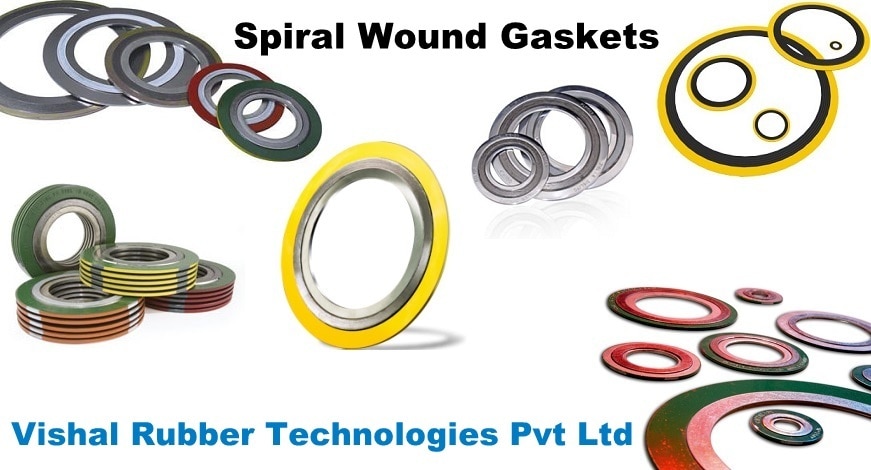
Spiral Wound Gaskets:
Spiral-wound gaskets comprise a mix of metallic and filler material. Generally, the gasket has a metal (normally carbon rich or stainless steel) wound outwards in a circular spiral (other shapes are possible) with the filler material (generally a flexible graphite) wound in the same manner but starting from the opposing side. This results in alternating layers of filler and metal. The filler material in these gaskets acts as the sealing element, with the metal providing structural support.
These gaskets have proven to be reliable in most applications, and allow lower clamping forces than solid gaskets, albeit with a higher cost.
Spiral wound gaskets have proven to be the most reliable sealing element for use in difficult, critical and arduous duties. Spiral wound gaskets are used in Refinery, Petrochemical, Chemical, Steam lines and Process Industries, where they have many advantages over older types of gaskets.
These gaskets are manufactured to International specifications such as BS, API, ASME, DIN.

 Chat with us
 Chat with us